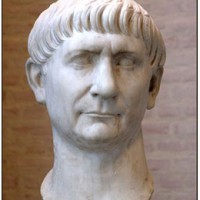
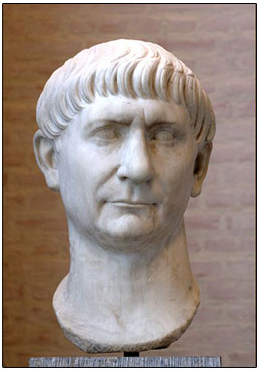
Like the Egyptians, ancient Roman leaders went to great efforts to create monuments to celebrate and commemorate their victories in battle. The Romans appropriated many cultural forms and structures when they conquered other lands. The basic form of the column erected by the emperor Trajan (Figure 1) in Rome was inspired by the Egyptians’ obelisks, but its function was very different.
-
- Figure 1
-
- Figure 2

-
- Figure 3
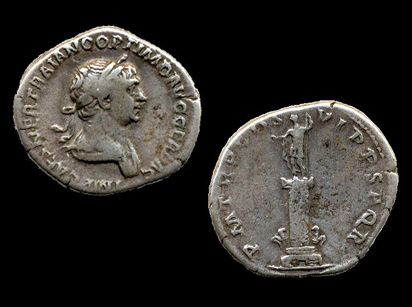
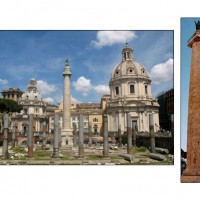
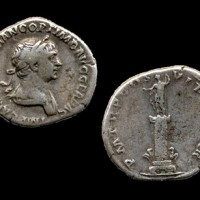
Trajan (53 CE – 117 CE) erected his column to commemorate his victories over Dacia, the land across the Danube now known as Romania. Trajan first attacked Dacia in 101 CE, and again in 105 CE, when the area was incorporated into the Roman Empire as a new province. The column was completed in 113 CE. Trajan returned from Dacia with vast amounts of war bootie, which he used to create a new Forum. Laid out like a military camp, Trajan’s Forum had the column as its centrepiece (Figure 2). The column was depicted on the reverse side of a silver denarius coin, with Trajan’s image on the obverse side (Figure 3).
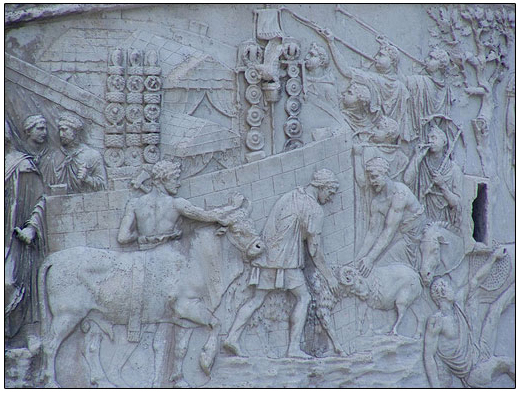
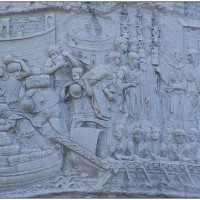
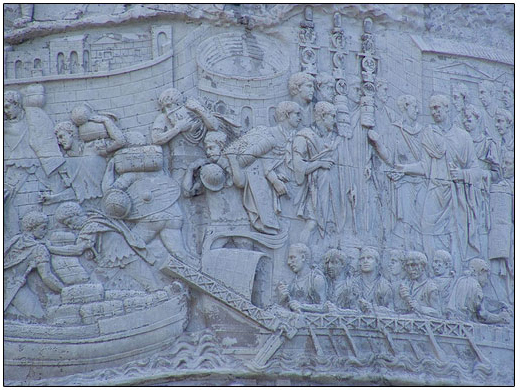
We can see in Mary Harrsch’s photographs of Trajan’s Column that it depicts, in great detail, episodes from Trajan’s two campaigns, beginning with making preparations for the invasions at the bottom levels, including preparations for the sacrificing of a bull to ensure a successful campaign, an important Roman ritual known as a suovetaurilia (Figure 4), and loading ships for the crossing of the Danube (Figure 5).
-
- Figure 4
-
- Figure 5
-
- Figure 6
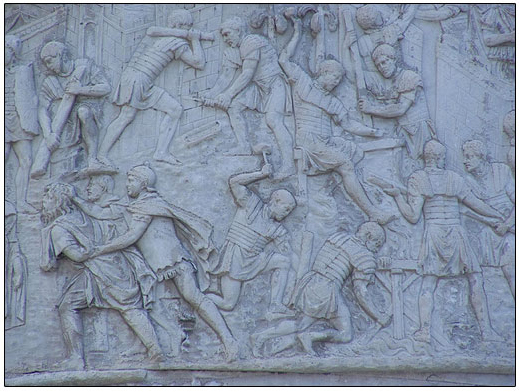
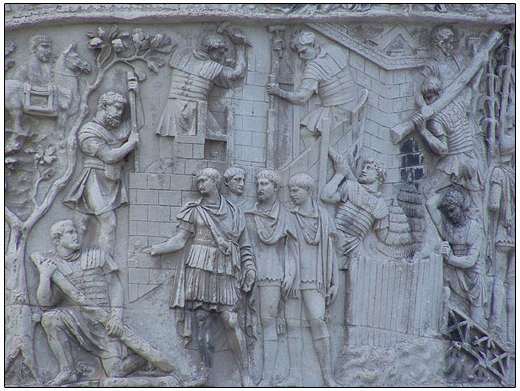
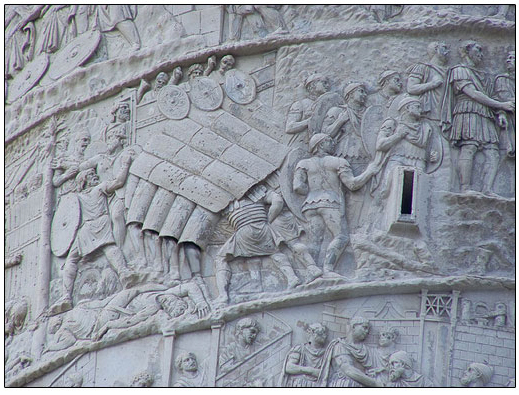
Other scenes show soldiers building a bridge while a captive is lead away to the left (Figure 6), building forts (figure 7 and 8), and going into battle holding their shields in the interlocking testudo (tortoise) formation (Figure 9).
-
- Figure 7
-
- Figure 8

-
- Figure 9

The ascending narrative of the column culminates with scenes showing the Dacians being evicted from their homeland at the top (Figure 10).
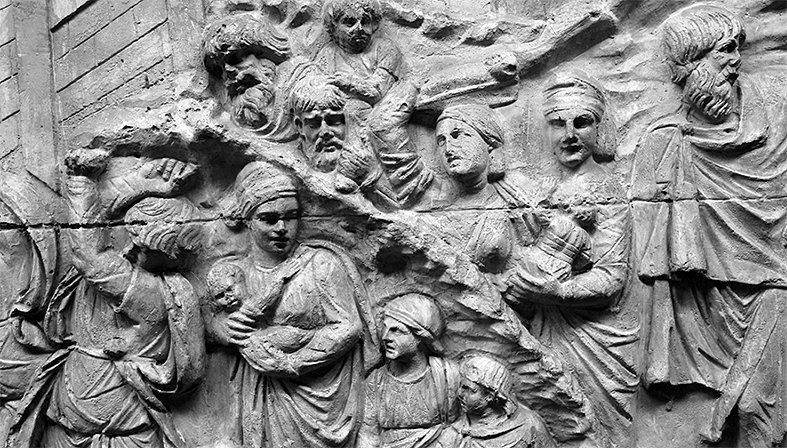
Figure 10
Trajan’s Column is a triumphal column in the same way as the Arch of Titus (Figure 11) is a triumphal arch.
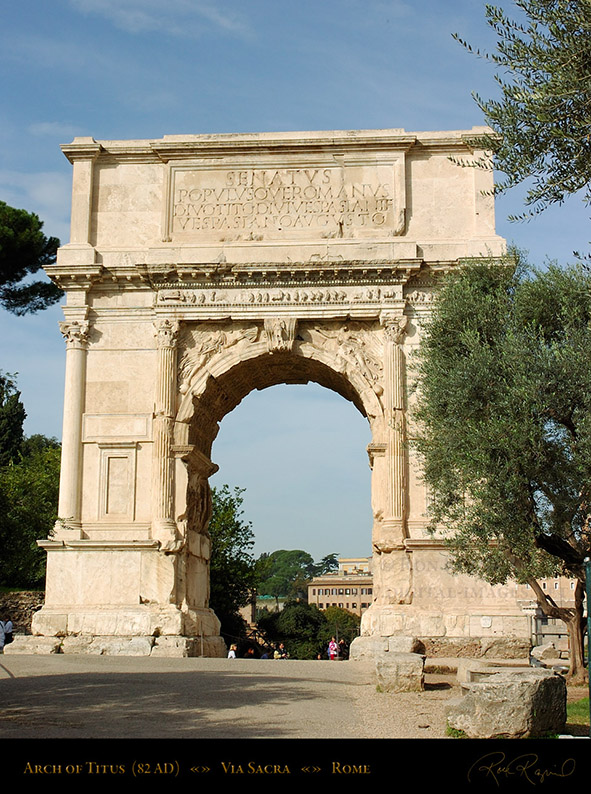
Figure 11
It is also Trajan’s funeral monument: the Roman Senate voted to place his and later his wife Plotina’s ashes in its base after his death, although they are no longer there.
The vignettes on the sides of Trajan’s Column are arranged in a narrative form, as a spiralling or helical sequence in such detail and accuracy that they provide researchers with valuable insights into how the Roman army was outfitted and organised, and the tactics and war machinery they used. Activities portrayed include gathering food, medics attending the wounded, soldiers building, marching and fighting. Details of the lands the Romans passed through are also included. The marble figures are about 2/3 full size (Figure 12).
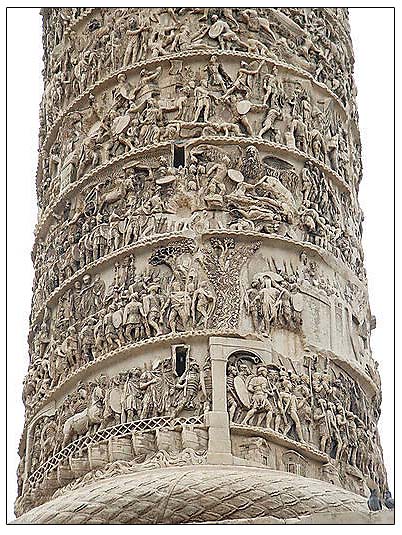
Figure 12
What the scenes do not show is as interesting as what they do. The ugly, violent reality of warfare is downplayed. The narrative focuses on scenes which show the Roman army completely in control or engaged in peaceful, constructive activities. The message of the column to the citizens or Rome, at a time of financial difficulty for the Empire, was clear: only through ongoing successful military campaigns against its neighbours could Rome continue to thrive and expand. Trajan sought to justify his continuing involvement in military campaigns by emphasising the positive.
Those citizens who climbed to the top of the column (no longer permitted) were rewarded with sweeping views of the city which were intended to remind the visitor of all that Trajan had created through his conquests and what a great benefactor he was for Rome. At around 42 meters high including the base, the top of the column marks the high point of an entire hill that Trajan had removed to accommodate the new Forum complex. Obviously, the scenes represented in the uppermost spirals are not easily viewed from ground level, and why this is so has mystified commentators over the nearly 2000 years since it was built.
Why did Trajan go to so much trouble and expense to create detailed relief sculptures which people would not be able to get a clear view of any way? Under normal circumstances only the bottom section is readable and therefore verifiable in terms of historical accuracy and continuity.
One theory is that generally people knew all about the Dacian campaigns anyway, so it was not important to be able to see each episode. It has also been pointed out that at the time it was built it was possible to see more of the column from the roofs of adjacent buildings, although even then it would not have been possible to read the work in its entirety.
Another theory is that the relief sculptures on the exterior are not as important as the fact that a visitor could climb the spiral staircase within, from the base containing Trajan’s ashes to the bright light of the viewing platform at the top, in a metaphorical ascension repeating Trajan’s climb, politically and spiritually, into the heavens. The blaze of sunlight on exiting the dark interior of the column would thus symbolise Trajan’s transformation in status from mortal to divine, at the same time as the spiralling exterior represented his forceful, continuous leadership qualities. According to this interpretation of the column’s role, the ability to read the narrative in its entirety would almost be incidental.
“Why is it that a helical relief, a form that emphasises continuity, would imply continuity yet remain unverifiable to the Roman observer? One answer to this is that the autonomy and authority of Trajan and his column is emphasised over the person who wishes to exercise his/her empirical, ascertaining judgments.” (From “Vertigo and Vanity: A Study of Trajan’s Column” by Heather McDonald.)
In other words, according to McDonald, the primary role of the column was to reinforce the divine status of Trajan and his accomplishments. If as a Roman you felt short-changed or cheated because you could not follow the story depicted on it, well…tough.
Like Rameses’ artists’ representations of the Battle of Kadesh, Trajan’s Column is war art in the service of officialdom. Both examples are based on historical fact, yet they have less to do with objectivity than with manipulating the impressions that the subjects of Rameses and Trajan have of them as leaders.
A detailed overview the scenes on Trajan’s Column can be viewed at the following website:
http://www.trajans-column.org/?page_id=107