
Figure 1
The principal aim of my website is to pay tribute to the New Zealand artists and craftsmen who went to war in the Pacific in the Second World War, as well as to provide an informative resource for students and other researchers in this area. With recently proposed (and surely overdue) changes to the New Zealand curriculum to emphasis New Zealand’s unique history, especially the colonisation of Aotearoa and the subsequent Maori Landwars, and our place in the world and role in the Pacific, I feel the launching of my website is timely.
Growing up in Henderson, West Auckland, in the 1950s, I was intrigued by the two model airplanes, vase and letter-knife that my father made while he was “away at the war” in 1943 and 1944.
While stationed on Mono and Stirling Islands in the Treasury Group, Gunner Harry Stone had created these simple artworks from spent shell cases and bullets which he had carefully “deloused”, or drained of gunpowder (thus earning the threat of court-martial for misusing his own ammunition) and had chrome-plated on his return to New Zealand in 1944. These objects took pride of place in the family china-cabinet, bearing silent testimony to the war experiences Harry himself rarely talked about right up until the time he died in 1994.

Figure 2
Today, I profoundly regret not pressing my father to talk more about his experiences in the Pacific. It is common for war veterans to suppress their wartime memories, partly because they don’t think people are very interested in them, but mostly I believe because they just want to put the experiences behind them: to mentally delete the events and look to the future. The generation of Second World War soldiers who returned to produce the Baby Boom of the 1950s wanted to create a brave new world: one that was free of war and conflict. Unfortunately this involved suppressing a lot of memories which later came to haunt them. This certainly happened with my father in the last years of his life.
I regret not reading his diaries before he died in 1994, even though I used to see him transcribing (and editing) them at the kitchen table on his portable typewriter whenever I visited. There are so many questions that he could have answered if only I had engaged with him more at the time.
But I was busy too: holding down a teaching job, producing a body of work as a creative photographer, and raising a family. So I’m not too hard on myself for not bringing Dad’s wartime experiences out into the open: we just didn’t know. The portrait of my father in Figure 3 was taken at home in Red Beach, Whangaparaoa in 1981. It was one of the portraits in my photographic survey “The Hibiscus Coast Project”, exhibited in the Auckland City Art Gallery that year (the images from the project are accessible on the Auckland Art Gallery website). Dad was 61 years old at the time: younger than I myself am in 2019.

Figure 3
Between 1997 and 2016, I held the position of Head of the Visual Arts Department at Mount Roskill Grammar School in Auckland. In 2009, motivated by the urge to find out more about my father’s wartime experience and the wish to evaluate the role that the visual arts played in the lives of New Zealand servicemen in the Pacific, I applied for and was awarded a one year Teachers’ Fellowship by the Royal Society of New Zealand to investigate and analyse art and artefacts produced by New Zealand soldiers in the Pacific theatre in World War Two.
My successful application enabled me to devote 2010 not only to full-time study of the breadth and variety of art produced by New Zealand soldiers in the Pacific, but also to reading and transcribing my father’s three war diaries, and an intensive study of the historic contribution New Zealand made to the effort to defeat the Japanese in the Pacific.
This website is the result of my investigations. It has been a long time in the making. Pressures of secondary school teaching, moving house, as well as family illness and deaths all took their toll of my time and determination. The website self-destructed just before it was due to be published and had to be rebuilt almost from scratch. Retirement from teaching in 2016 created the opportunity to finally complete and publish the website.
Harry Stone’s unit, the 54th Anti Tank Battery, was attached to the 36th Battalion. In my research I came across the small commemorative booklet about the Battalion mentioned elsewhere on the website. It contained the following poignant poem by Gordon Watson (Figure 4):
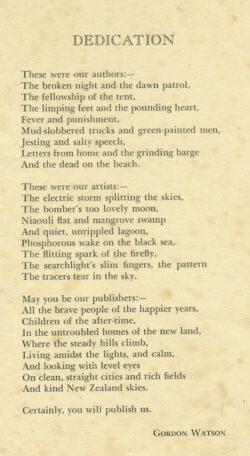
Figure 4
Sadly, I was not able to discover anything about Gordon Watson. He is not mentioned on the Auckland Museum Cenotaph website. Watson is just another ghost from the war whom we know nothing about.
We are “the brave people of the happier years, the children of the after-time”. I hope Gordon, and his comrades in arms, would be pleased with what I have created for this website.