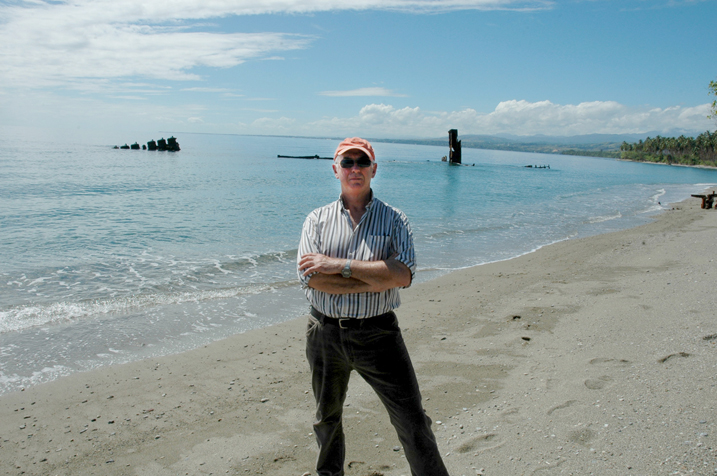
The photograph shows me, on Bonegi Beach with the remains of the Japanese transport the Kinugawa Maru in the background.
As I worked on transcribing my father’s three war diaries and the introductory chapter he wrote after the war, the title of John Mortimer’s play, “A Voyage Round My Father” sometimes came to mind. To me Mortimer’s title suggests a objectified evaluation of the individual, lacking a personal involvement.
As I came to know him more through reading the diaries, Mortimer’s title gradually morphed into “A Voyage Alongside My Father” because I felt I was reliving his experiences with him as I read. He came alive again for me through his writing, and there were times I felt I was listening to him as well as supporting him. I felt my hand on his shoulder as he wrote. There were times I felt his hand on my shoulder too.
It must be stated from the outset that my father did not consider himself a hero, and he stated this himself in his diary during the invasion of Mono Island, when he took shelter under a truck as shrapnel from Ack-Ack guns was clattering around him on the deck of his LST. As a Gunner attached to an anti-tank unit, he was not part of the initial invasion force; rather his ship landed immediately after the Infantry went ashore. He says that as a Gunner he was “spared the horrors of jungle warfare”, although it was his duty to collect some of the 40 New Zealanders killed that morning in his truck and take the bodies back to the LST to be taken off the island.
Obviously, it is impossible to recreate the conditions that the servicemen on Guadalcanal endured at the time, and it is sobering to reflect that the township of Honiara did not even exist in 1943: the area just was coconut trees, scrub and jungle. Yet visiting the places my father had written and talked about, the scenes of the battles and fire-fights I had read about in my research, certainly helped me to come to terms with what New Zealand servicemen, my father among them, had experienced almost seventy years before.
Life in army tents in the baking heat and tropical downpours characteristic of the island must have been very harsh, in Guadalcanal and the other islands. Trepidation about what was ahead for them and homesickness must have gnawed at the men constantly. Reading between the lines of his diaries, his repeated thoughts about Home, “good old New Zealand”, his family and new wife, his continual references to wanting to sleep, his expressions of hatred of life in the army, I believe my father was very likely suffering from depression during his time away from New Zealand. There was no chance of my father boarding a jet and being back in home in a matter of hours. New Zealand must have seemed very far away.
Harry did not want to be in the war. He held no particular animosity toward the Japanese, although he accepted that their expansionism had to be stopped. He was in the Solomons because he had sworn allegiance to his King and Country and his government had sent him there. He was in his own words no hero. He wanted to survive. He wanted the war to be over so that he could return safely to New Zealand and start a family.
I expressed these thoughts to Rick Ottaway, General Manager of Veterens’ Affairs in Wellington. From his own experiences with returned servicemen, he agreed that most of the men felt this way. They all just wanted the world to return to normal.