
Figure 1
The photograph in Figure 1 above shows the American “Camp Hale” in front of the Auckland Museum in the Auckland Domain during the war. American and Kiwi military camps were set up all over New Zealand to train and prepare soldiers for service overseas. They were often based in public parks like this one. Another major American camp in the Auckland area was situated in Waikaraka Park in Onehunga. My father did his basic training at Kensington Camp, situated at Kensington Park in Whangarei. Between June 1942 and mid-1944 there were between 15,000 and 45,000 American servicemen in camps in New Zealand.
With England, the “Mother Country”, preoccupied with its own survival against the onslaught of the forces of Nazi Germany, New Zealand was inevitably drawn into a closer military and cultural relationship with the United States.
The US Marines who attacked the Japanese in Guadalcanal prepared for the invasion of the island while based in Wellington (Figure 2).

Figure 2
American servicemen wounded in the Pacific or suffering illness were also sent to New Zealand for treatment. There were more than 9000 beds for servicemen requiring medical care in New Zealand (Figure 3).
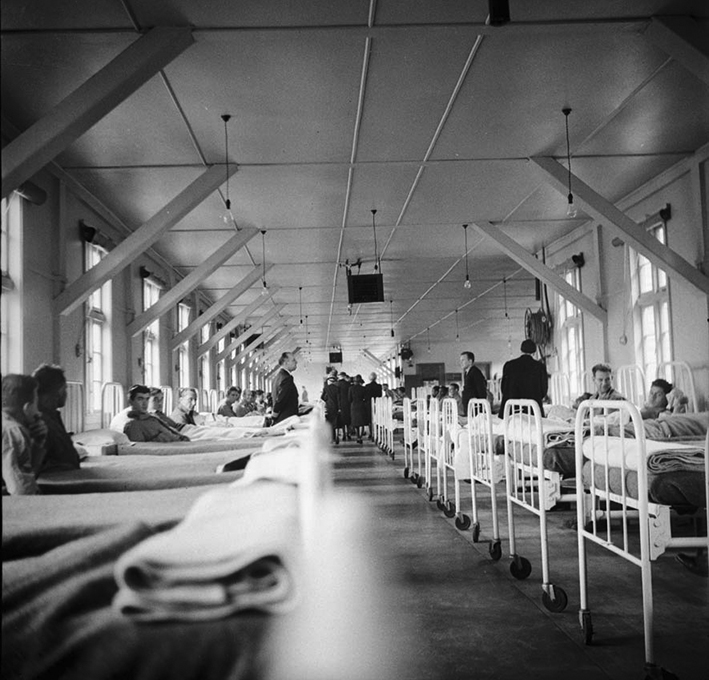
Figure 3
The War in the Pacific posed a real threat to New Zealand. The Japanese goal was to isolate, if not invade, Australia and New Zealand and use them as “bargaining chips” in their plan to create their own empire in Asia and the Pacific: their “Greater East Asia Prosperity Sphere”, a term comparable in cynical double-think with the Nazi’s declaration that “Abeit macht frei” (“Work Sets You Free”) posted above the entry gate at Auschwitz concentration camp).
America was committed to conquering Japan and reversing Japanese expansionism: the Americans were not interested in preserving the status quo regarding Britain’s “possessions” in the Pacific. Put simply, they were not fighting the Japanese to prop up Britain’s Empire as it had existed before the outbreak of war. New Zealand was seen as a valuable ally, but with a population of around 1.5 million at the time, of limited use militarily. In fact, the Americans could have waged the war without any assistance from the puny little country at the bottom of the world, and some American military and political leaders argued that it would be better if the Kiwis stayed out of it altogether.
According to Reginald Newell in his “Forgotten Warriors” Doctor of Philosophy thesis for Massey University, Vice Admiral Robert Lee Ghormley, appointed Commander of the South Pacific Area in 1942, wanted as little to do with New Zealand politics and military commitments as possible. He was insistent that New Zealand forces be used in a strictly garrison role to free American soldiers up for front-line fighting, even turning down an offer by the New Zealand government to send a full division to support the Americans on Guadalcanal.
“The United States had seldom fought in a coalition and there tended to be discordance when it did. Franco-American operations during the American War of Independence were unsuccessful except at Yorktown. World War I saw intense disputes with Anglo-French commanders on the use of the American Expeditionary Forces (AEF) and intervention in Russia was costly and bitter. The American desire to fight alone, or at least to dominate any coalition, arose from that history.” (“Forgotten Warriors”, Reginald Newell, 2008)
But New Zealand was keen to make a contribution to the War in the Pacific, if for no other reason than that it wanted a place at the bargaining table where the new political reality in the region when the war against Japan had been won.
Ghormley, seen by Fleet Admiral Chester Nimitz, Commander in Chief of Pacific Ocean Areas, as too negative and defeatist in his attitude to the War in the Pacific, was replaced by Admiral William “Bull” Halsey at the end of 1942. Nimitz stated to Ghormley at a meeting in Noumea: “We’ll see about using New Zealand and (US) Army troops (to support US Marines on Guadalcanal)…if we can’t use our Allies we are God-damned fools.” (“Forgotten Warriors”, Reginald Newell, 2008)
Under Halsey, “A complete shift in attitude…occurred. New Zealand troops were no longer seen as solely for garrison duty.” (“Forgotten Warriors”, Reginald Newell, 2008)
As a consequence, New Zealand was to be given the responsibility of dislodging the Japanese, with American logistical support, from the Treasury Islands, in “Operation Goodtime”, as well as in Vella Lavella and the Green Islands (“Operation Squarepeg”).
In the bigger picture, compared to 2NZ Division’s contribution to the war effort in Europe, the 3 NZ Division’s effort could be regarded as relatively minimal. The New Zealand public was disparaging about New Zealand’s efforts in the Pacific, referring to the soldiers sent to the islands as “coconut bombers” and comparing conditions there to life in a holiday resort. The fighting in Europe was regarded by most people as the “real war”.
The perception of limited contribution still exists for some. In the lavishly produced book “War in the Pacific” by Richard Overy, published in 2010 by Crows Nest, you will find New Zealand mentioned once (page 32). The country is not even included in the map of the Pacific in a publication heavily weighted toward the Australian experience. When I emailed an American author in 2010 querying why New Zealand was not mentioned at all in his book on the War in the Pacific, he messaged back that he only felt motivated to write about countries which had “made a substantial contribution”.
The 3rd Division was recalled to New Zealand in June 1944. There was no further need for them in the Pacific and there was a severe manpower shortage back home. Some chose to remain in the army and go to the European theatre. Harry Bioletti, a veteran of Vella Lavella, whom I interviewed for the website, was one. When I asked him why he had chosen this course of action, he replied that he wanted to stay with his mates, and, since he was unattached, he wanted to take up the opportunity for further travel at government expense. Other soldiers just wanted to go home. My father Harry requested to be repatriated to New Zealand and was able to do so because as a sawmiller he belonged to an “essential industry” which was experiencing a manpower shortage. On his return to New Zealand, he began work in a sawmill at Ranui in West Auckland.
The harsh reality of life in the wartime economy of New Zealand in 1944 soon hit. He was making about the same amount of money he had been paid in the army, but now having to support himself and my mother on it:
“I went to the Manpower Office and told them I could not live on such low wages. Their immediate answer was if I didn’t like it I could go back to the Army and go to Italy, as reinforcements were still needed in that theatre.” (Harry Stone, Auckland, June 1944. Diary No. 3)
The most profound effect of the War in the Pacific on New Zealand/Aotearoa was cultural. A shift occurred which saw an increasing alignment with American culture away from the British influence (not economic or political however: New Zealand was still seen as Britain’s “breadbasket in the Pacific” and would be for some years until the Old Country joined the EEC, later to become the EU). The experience of New Zealand forces living and fighting alongside Americans in the islands of the Pacific, of GI’s stationed in New Zealand bringing their food, music, films and other forms of popular culture with them, and for many marrying local girls, helped to awaken many Kiwi’s cultural consciousness of their neighbours across the Pacific.
It was a “love/hate” relationship all the same. Many Kiwi soldiers in the Pacific fretted about what their wives and girlfriends might be getting up to back Home. The phrase coined in the UK to describe the American presence in the lead-up to the D-Day landings – “overpaid, oversexed and over here” – must have resonated with the New Zealand servicemen and public as much as it did with their British counterparts.
If the military relationship between Yank and Kiwi personnel was generally characterised by the sharing of arms, equipment, resources and expertise, alongside that co-operation there were frictions and altercations. The Kiwis soldiers had a reputation for pilfering amongst the Americans, and were regarded by many G.I.s as unsophisticated, inexperienced freeloaders from an under-populated backwater at the bottom of the world.
The Americans in turn were seen by many Kiwi soldiers as brash, insensitive, randy blowhards who demanded that things were always done their way.
“I have found out why the N.Z. boys were stopped from going to the pictures for about a fortnight a while back. The N.Z. piquet, (Infantry), were on duty at the aerodrome where the pictures were held, when some Yanks started talking to the guard at the gates. They declared N.Z. was a “brothel” of a country, so one guard lay down his rifle and bayonet and started on one Yank. Then more Yanks came and more Infantry, until it developed into a grand brawl. The American nurses, (from the Hospital), when wishing to go to the pictures, have to go with an armed guard, because of the way the Yank troops behave. The nurses usually keep out of sight in the projector box shed. When they arrive and leave is when the trouble starts. The kindest thing I have heard them say is, ‘Chuck your tits out, sister'”. (Harry Stone, New Caledonia, Sunday 23 May 1943. Diary No. 1)