
Figure 1
The pencil drawing in Figure 1 is a self portrait of Russell Clark (1905 – 1966) from the Colin Moyle collection. The small self portrait from 1943, in Army uniform and helmet, reveals Clark to be a wiry, self confident individual of 38. This drawing is a superb example of Clark’s powers of self observation and prowess with a pencil.
Clarke is the most well known and arguably the most talented of the official New Zealand Pacific War Artists. He was born in Christchurch, where he worked as a commercial artist after leaving Canterbury College School of Art in 1927. He moved to Dunedin in 1929, where he had been offered work with a publishing company. For several years beginning in 1932 he ran art classes on Saturday mornings and weekday evenings. During this time he briefly taught painters Colin McCahon and Doris Lusk.
Clark moved to Wellington in 1938, taking a position as designer and illustrator with the newly formed New Zealand Listener. He also began a long association with the Education Department, producing illustrations for the School Journal. As well as being a skilful illustrator, Clark was also a highly respected exhibiting artist, and at various times exhibited with the Otago Art Society, Christchurch-based The Group, Wellington’s New Zealand Academy of Fine Arts and the Auckland Society of Fine Art.
In 1942 Clark wrote to New Zealand Prime Minister Peter Fraser offering his services as a war artist. He was called up later that year but his position was not confirmed until the beginning of 1944, when he was given the temporary rank of second lieutenant and sent to the Solomon Islands. He made drawings recording the activities of the New Zealand Army, Navy and Air Force in most of the locations Kiwi servicemen were involved in in the Pacific.
He returned to New Zealand in November 1944 with the repatriation of the 3rd Division and was posted to the Army Education and Welfare Service. During this time, Clark made many studio paintings, mostly water-colours, based on the drawings he had completed while he was away. Some of his paintings were also based on photographs taken by New Zealand official war photographers in the islands.
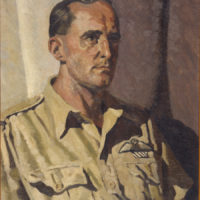
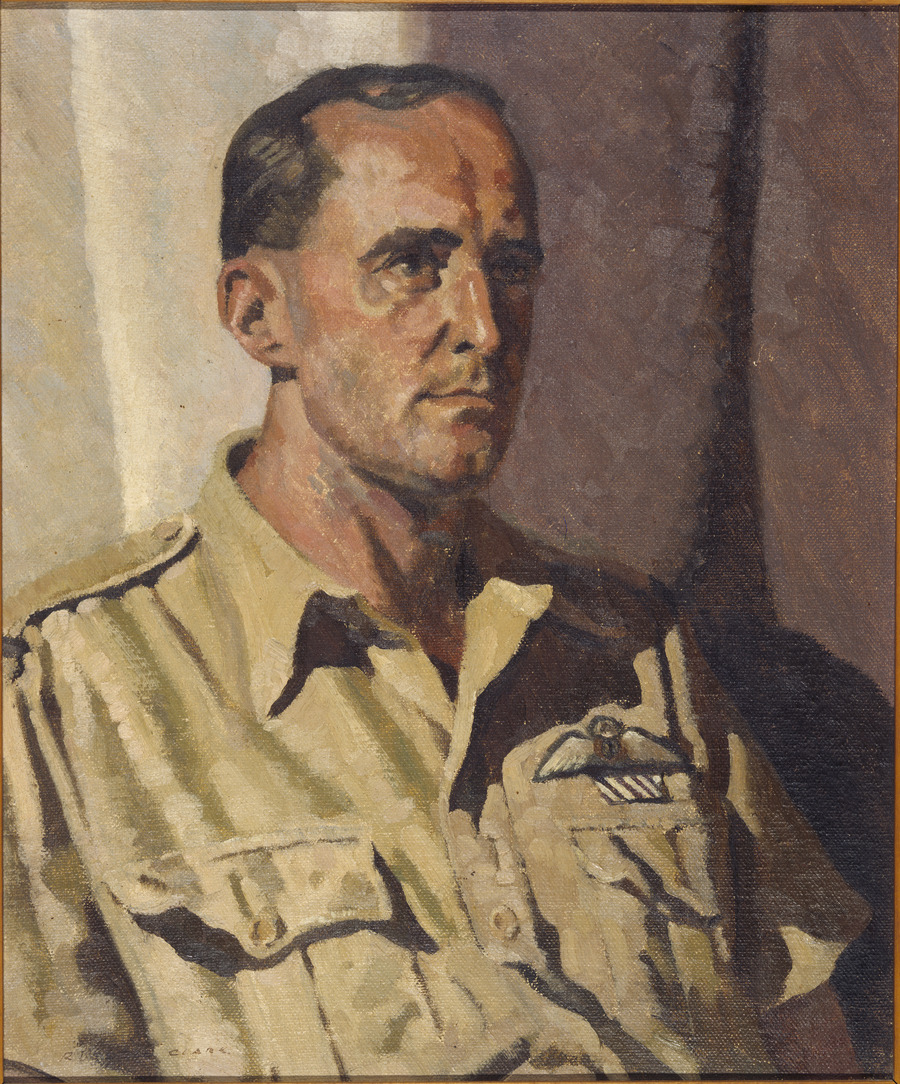
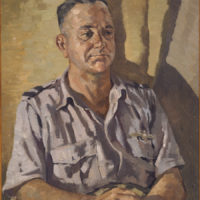
Part of Clark’s job-description as war artist was to produce formal portraits of distinguished servicemen, and he did this very well. Clark’s official portraits are solid representations of his subjects, competently handled and possibly made from photographs.
They were his “bread and butter” paintings (Figures 2 and 3). In February1944 Flight. Lieutenant D. S. Beauchamp was in charge of a Catalina patrol which rescued five downed American flyers from a B-24 Liberator in waters off 160 km. south of Nauru, for which he received a DFC. This example was probably made in New Zealand in late 1944 after Clark returned from overseas , with more time to devote to this formal type of work.
Clarks style was very eclectic, reflected his training and experience as an illustrator and borrowing openly from artists he admired including Paul Nash and Graham Sutherland. In “New Zealand Painting: an Introduction” by Gordon Brown and Hamish Keith, first published by Collins in 1969, the authors state with faint praise that “Clark never denied such influences and to some extent his ability as a craftsman compensated for his lack of originality.”
Original or not, Clark, with around 100 exquisitely rendered works in the National Archives war art collection and many more in other collections around New Zealand, created a thorough, historically invaluable record of the experiences and activities of Kiwi servicemen in the Pacific War.
-
- Figure 2
-
- Figure 3

-
- Figure 4
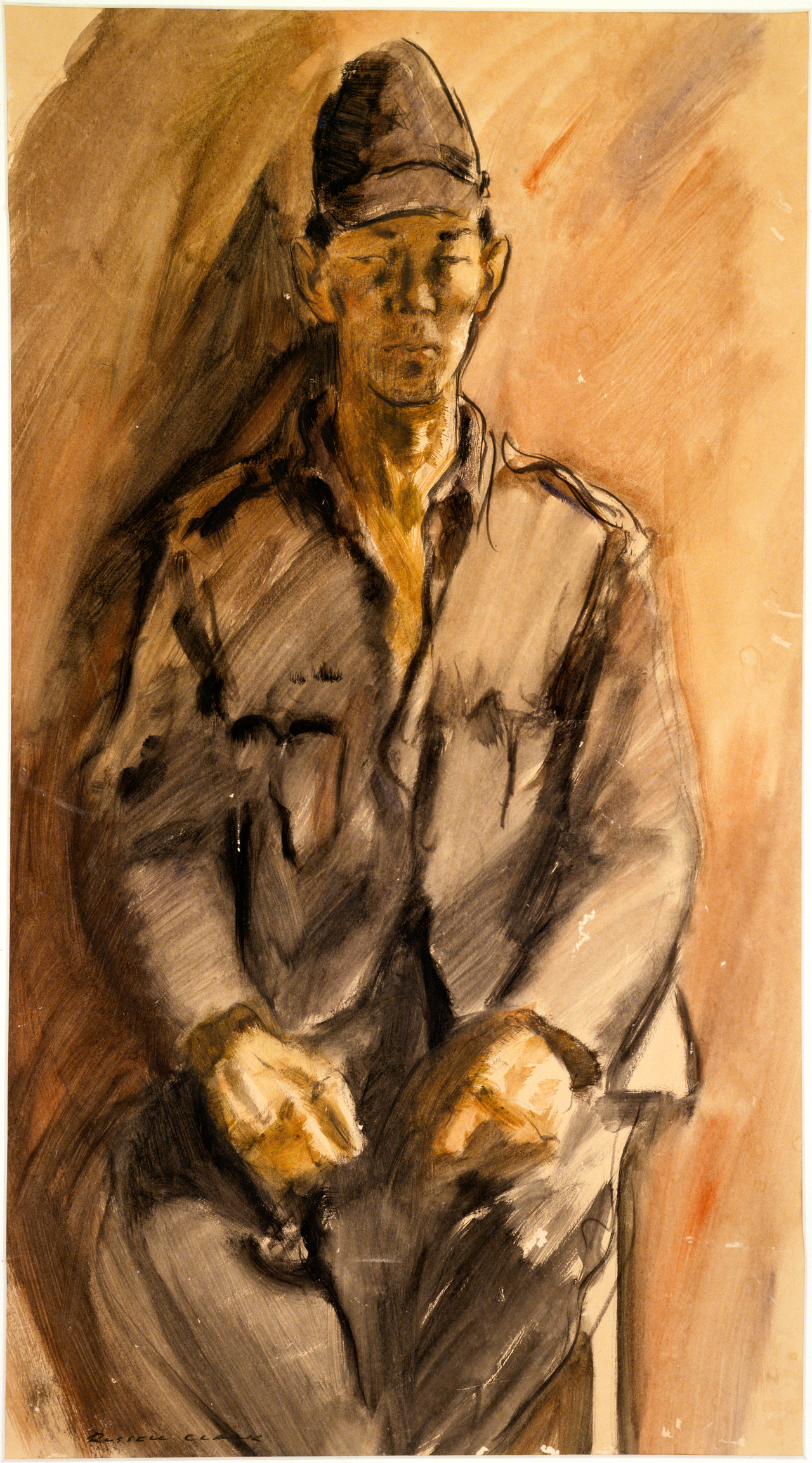
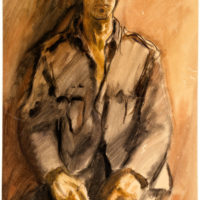
Figure 4 shows a portrait of a captured Japanese soldier, possibly the same man who was detained in the military hospital set up on Mono Island whom my father mentioned in Diary No. 3 when he was resident there with an infected toe:
“There are four others of our battery here, in this tent there is one “Anti Tanker”, a Yank and another L.A.D. chap. There is also a native patient (Sam) and a Jap prisoner (P.O.W.).” Saturday 18th December 1943:
This is a less formal, more spontaneously painted, and more sensitive portrait, apparently done in-situ, which is at odds with official Allied propaganda that the Japanese were uncivilised subhumans who deserved to be treated with loathing, suspicion and fear. The young man, who clearly must have agreed to sit for his portrait, looks out of the picture at us, sitting erect, apprehensive yet dignified. We are reminded of the fact that many of these young Japanese soldiers, in their unquestioning obedience to their Emperor, had little idea why they were fighting, let alone where they even were in the Pacific.
Clark’s most interesting work records the wartime appearances of the places he visited and the daily lives of the servicemen he encountered. He spent most of his service time in the Solomon Islands and as a result left a substantial body of work which records the conditions at the time. He depicted many of the places that my father would have been familiar with in New Caledonia, Guadalcanal, and Mono and Stirling Islands.
-
- Figure 5
-
- Figure 6
-
- Figure 7

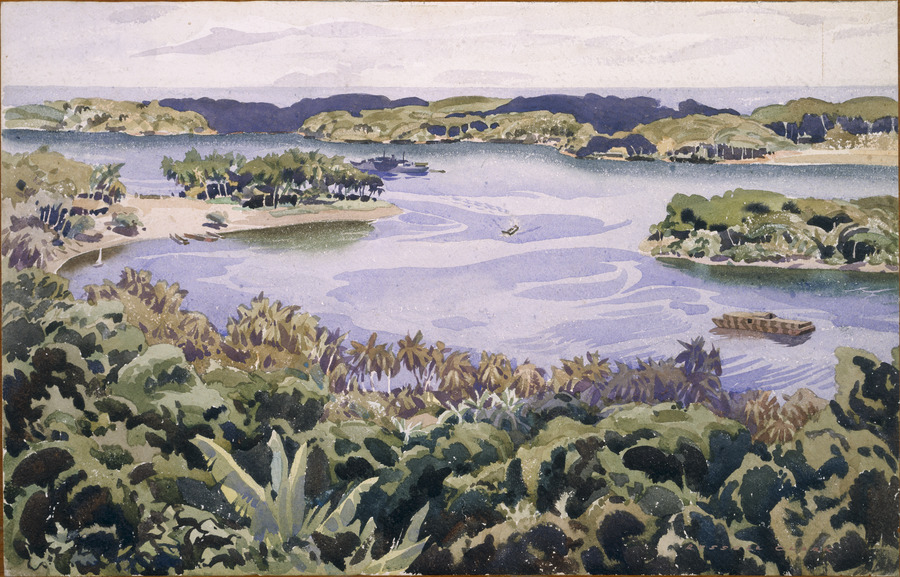
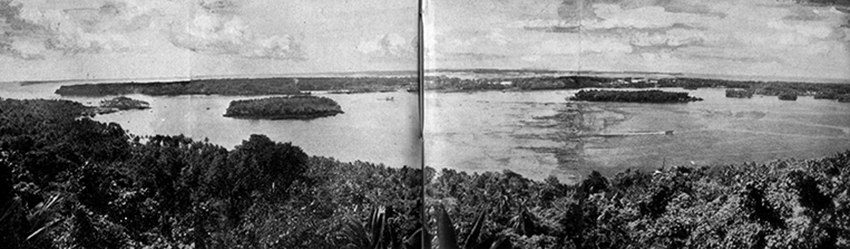
An watercolour overview of Blanche Harbour, separating Mono Island from Stirling, is shown from a hill on the main island (Figure 5). Falamai village, where the main 8th Brigade invasion occurred, is on the left of the painting. Wilson’s Point, where my father Harry Stone was stationed, is just outside the frame at top left. There is no evidence of the air-strip on Stirling Island, which suggests that this view depicted the situation immediately after the invasion of the Treasuries on October 27, 1943. It appears that the painting was based on a panorama photograph of Blanche Harbour taken soon afterward (Figure 6). The painting conveys the idea of an idyllic, peaceful tropical setting, while the photograph carries an ominous sense of potential conflict, enhanced by being taken from the Japanese position that the New Zealand invasion forces were bombarded from.
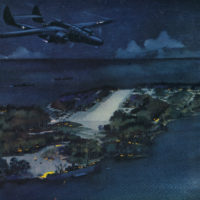
It is interesting to compare Clark’s version with a painting of the island airstrip at night at the height of the war by American war artist Robert Laessig (Figure 7). Laessig’s painting includes a P-61 Black Widow night-fighter.
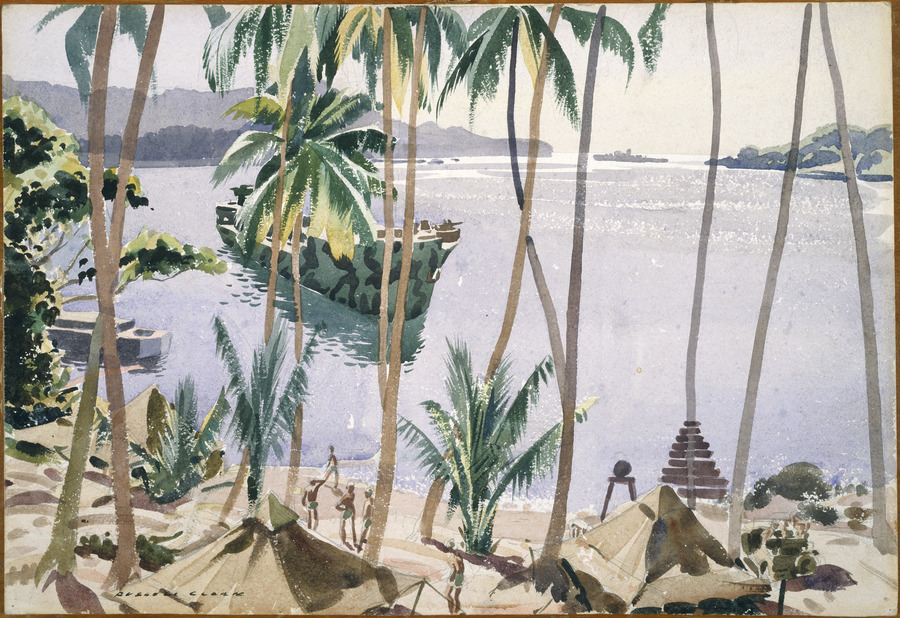
Clark had a fascination with representing the effects of light and responded to the challenge of recording the bright tropical light of his surroundings. This is seen in his exquisite rendering in water-colour of the 8th Brigade Head Quarters on Stirling Island (Figure 8) in which he skilfully captures the crisp, glittering light and translucence of the water. The HQ was moved to Mono Island to make way for the airstrip, which confirms that these two water-colours must have been made from photographs that were taken in late 1943 – early 1944.
-
- Figure 8
-
- Figure 9
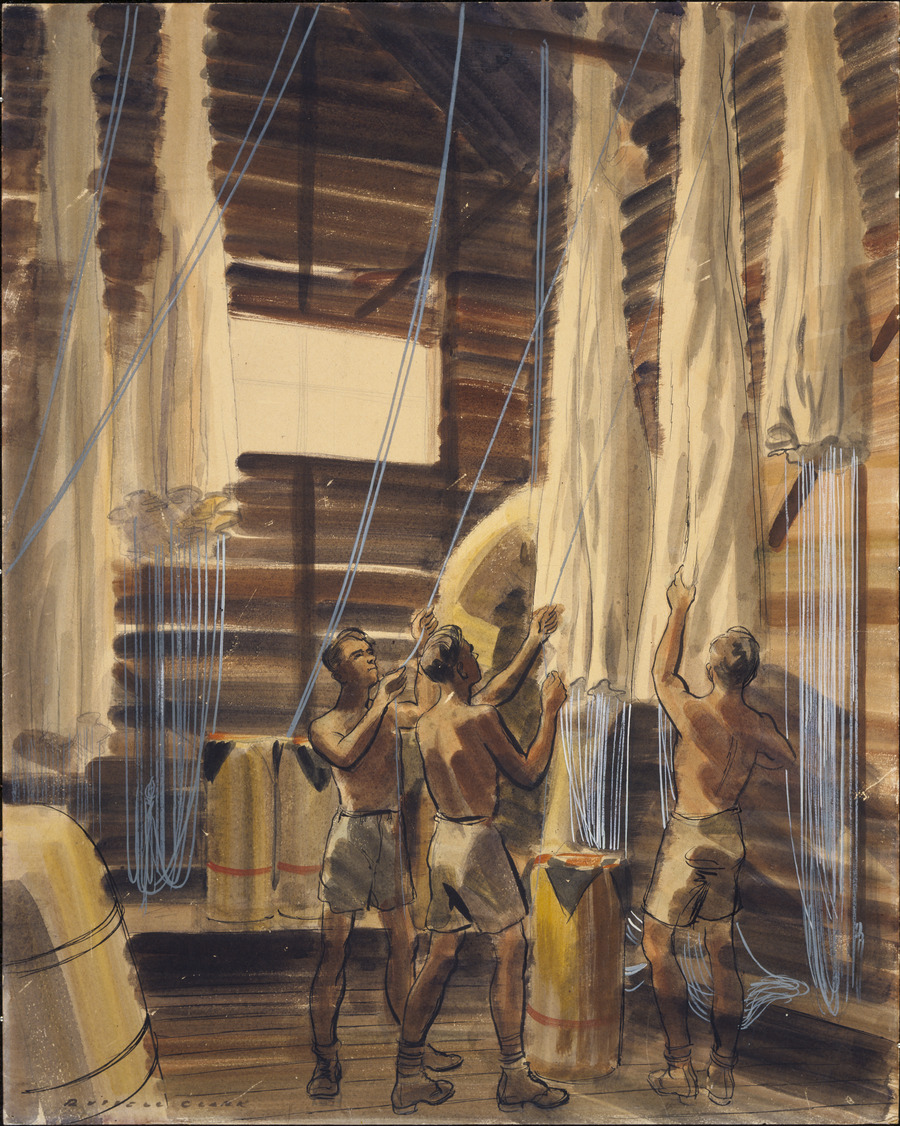
Clark appears to have delighted in subject matter that tested and demonstrated his superlative rendering skills, whether they be sunlight on water or the shimmering quality of silk parachutes being hung up to dry (Figure 9).
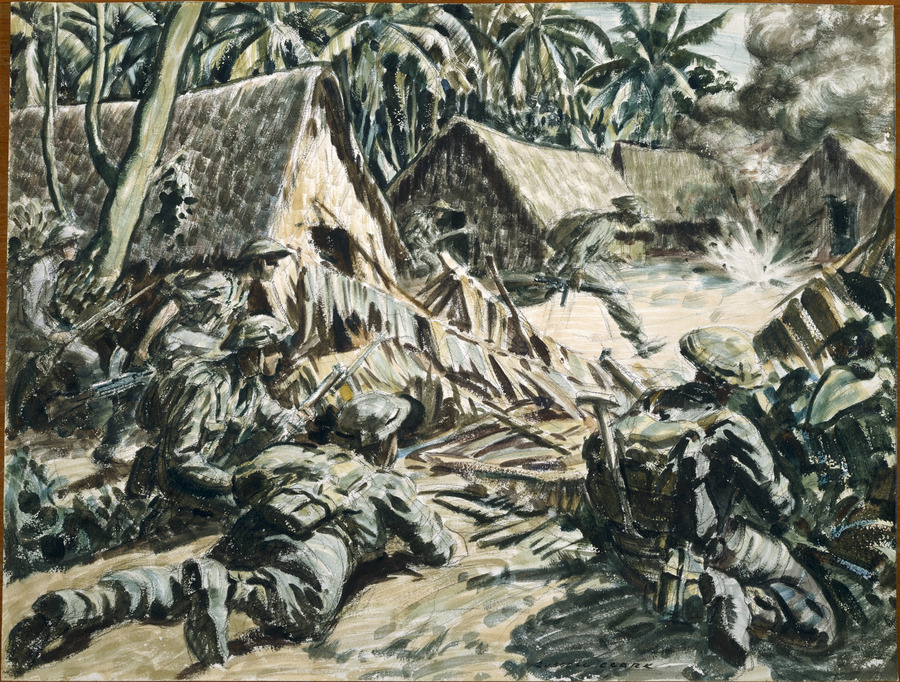
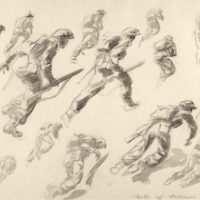
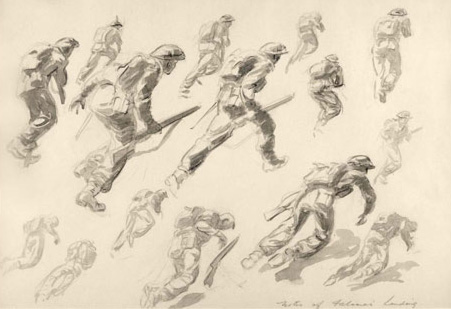
Clark attempted to convey an idea of what the invasion of Mono Island must have been like through a set of paintings, completed after the war, partly using photographs, figure studies of soldiers in action and observational drawings. “Action at Falamai” (Figure 10) depicts the fighting as the Infantry drove the Japanese from the area around the village. Preparatory drawings in ink wash and water-colour explore the poses of the soldiers. Clark was a much more competent observer of the figure generally than Barns-Graham. The drawings in “Notes for Falamai” (Figure 11) showing figures in action which were clearly preparatory studies for this painting.
-
- Figure 10
-
- Figure 11
-
- Figure 12
The job of depicting soldiers in action was a difficult one and Clark must have used models to make some of these sketches. He clearly wanted to create as convincingly as possible an impression of the clamour of battle and the danger that the men faced in jungle warfare. His ability to convey these impressions of men in action is unique: Peter McIntyre, the New Zealand war artist with the 2nd Division in Africa and Europe, is the only other New Zealand war artist to do this successfully.
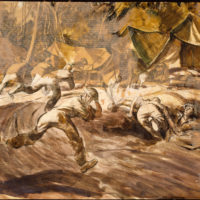
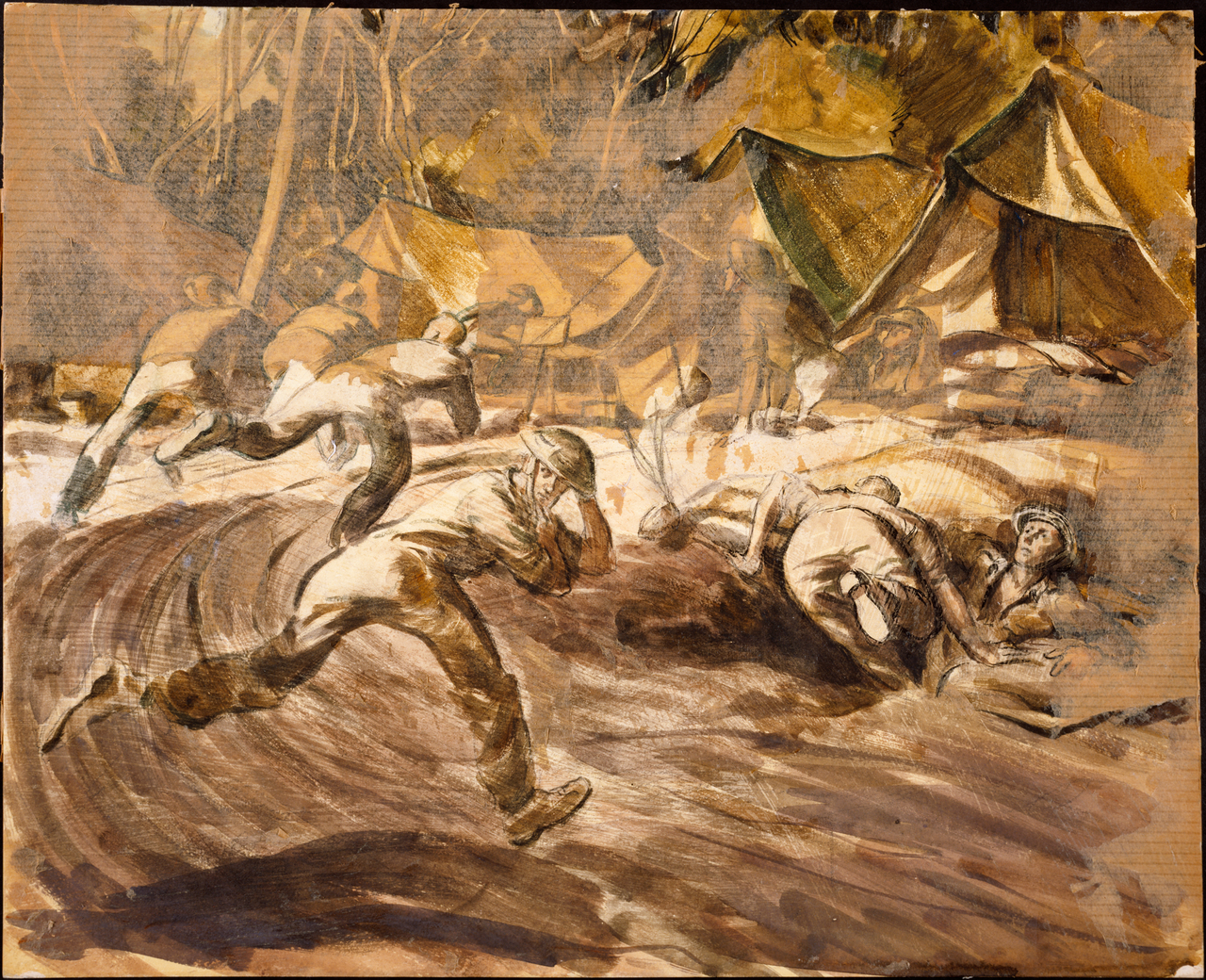
Clark’s impressionistic depiction of troops under attack (Figure 12) is a less specific, more generic image than “Action at Falamai”. It is not linked to a specific location but it was probably also made as a result of these figure studies. There is a dramatic sense of energetic confusion as the men run in different directions, dive into fox-holes and scan the sky for incoming shells or bombs. The wavy lines of the dirt road and collapsing tents in the background contribute to the sense of chaos.
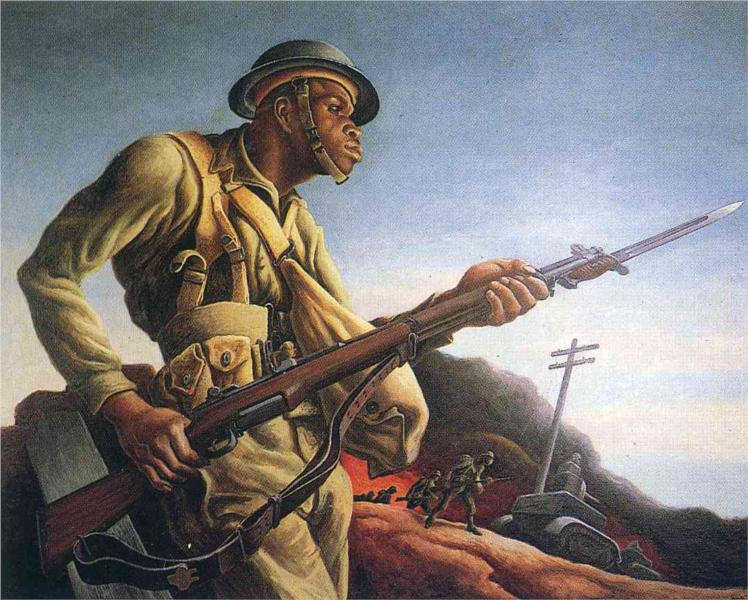
The khaki-sepia tones of the painting emphasise its army theme and the lot of the common soldier, while the curved lines of the road and distorted forms of the figures are reminiscent of the 1930s regionalist paintings of American artist Thomas Hart Benton (Figure 13).
-
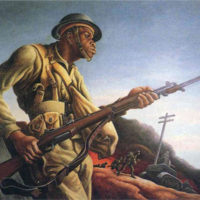
- Figure 13
-
- Figure 14
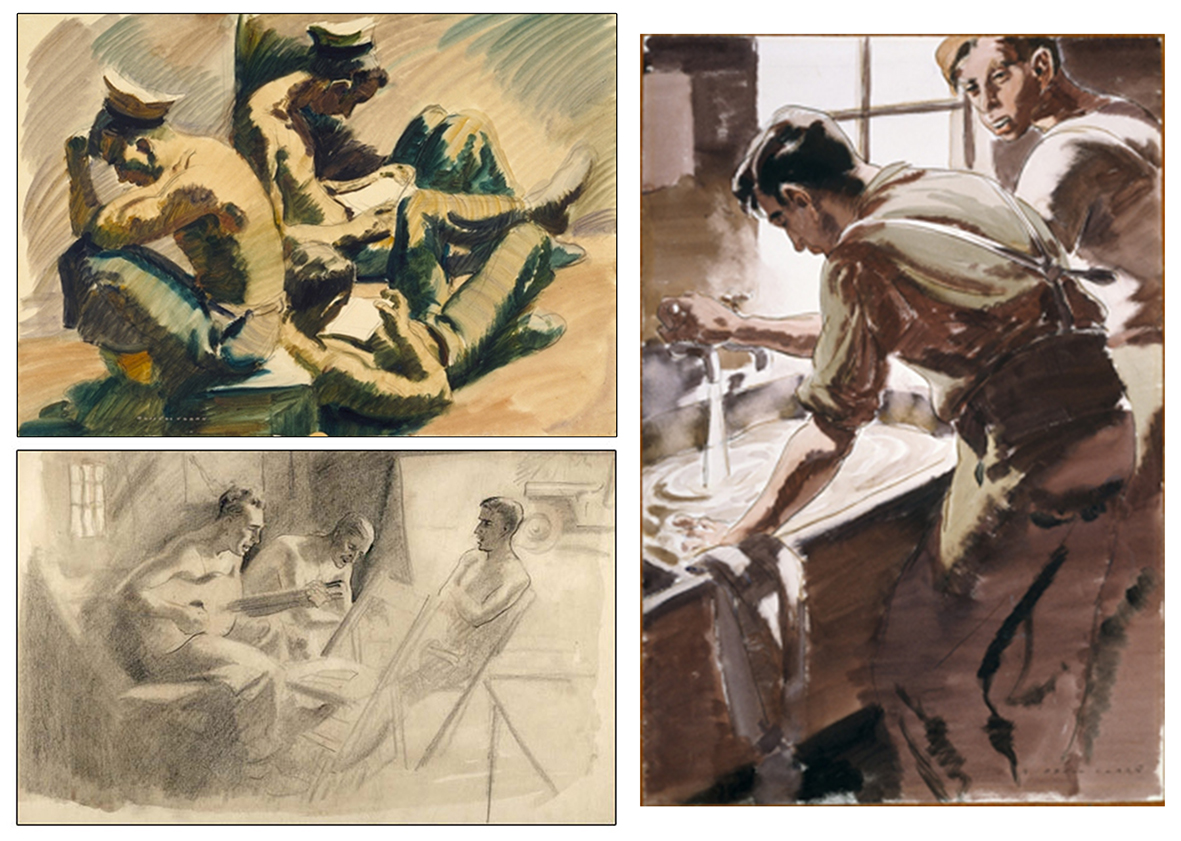
Clark’s looser, more fluid style of water-colour painting and sketching was excellent for capturing the everyday lives and activities of his subjects (Figure 14).
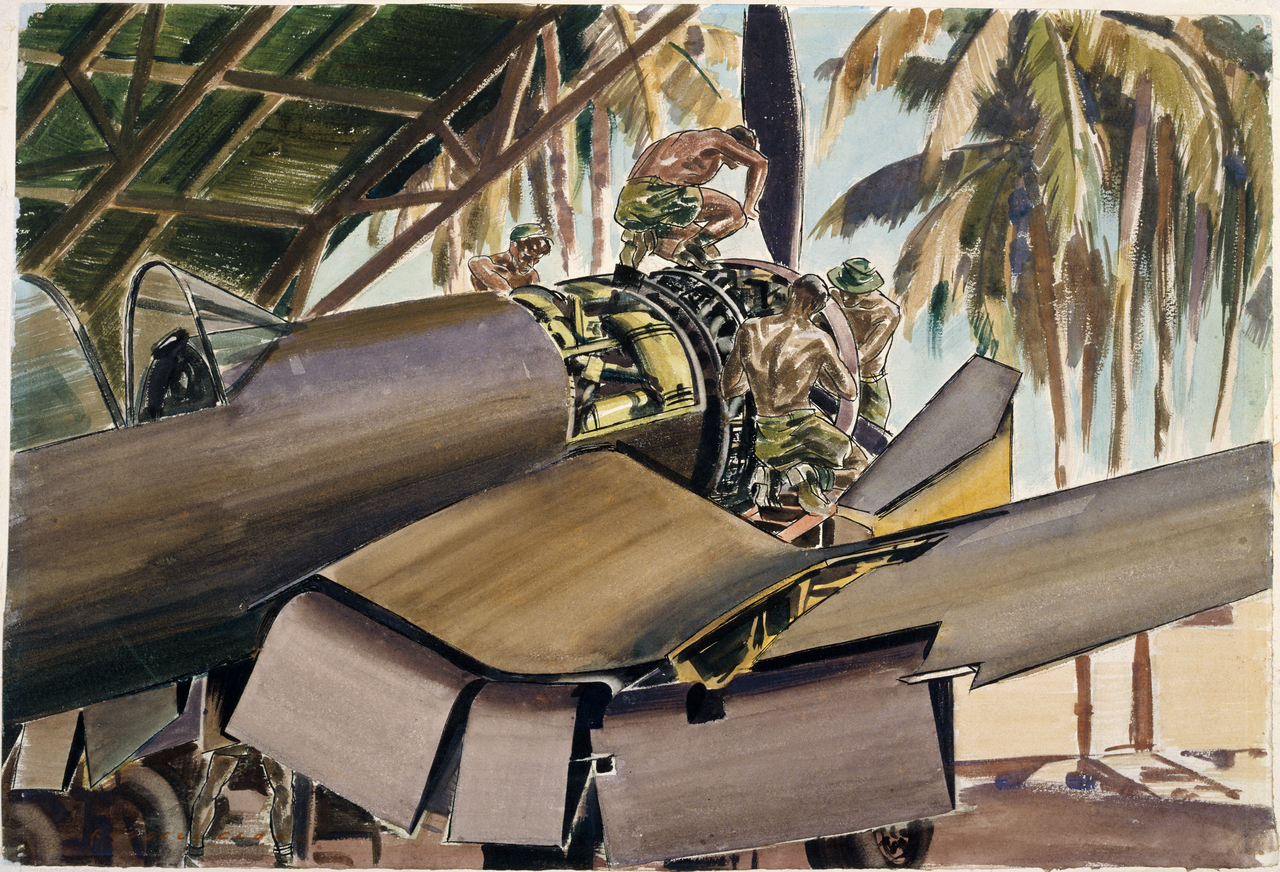
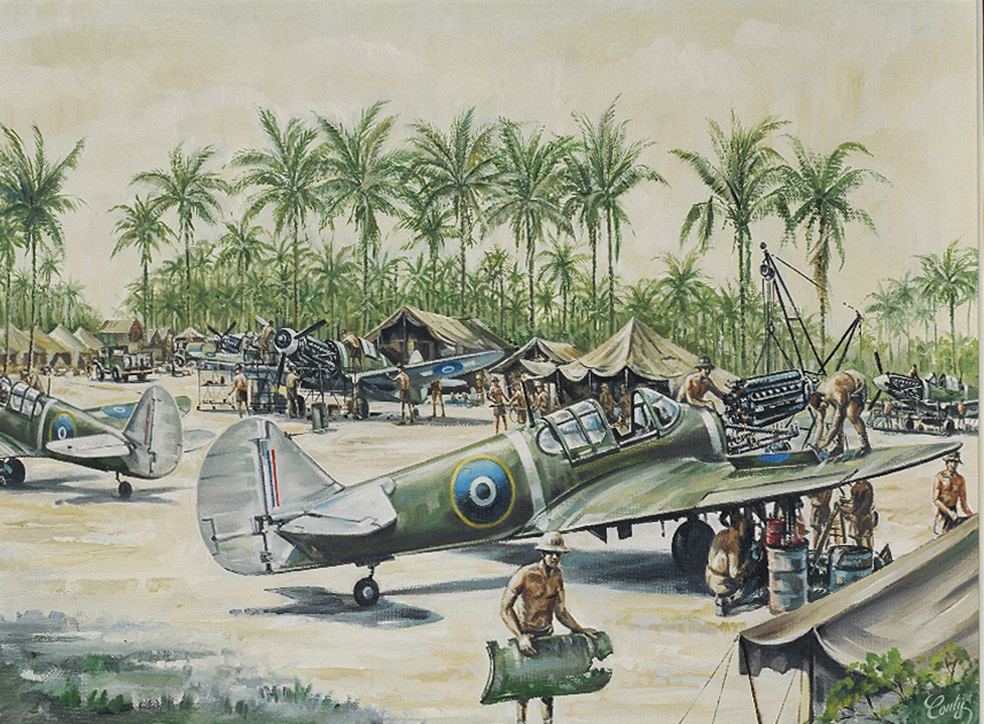
In this respect it is interesting to compare his representation of a maintenance crew working on a Corsair fighter (Figure 15) with New Zealand Air Force war artist Maurice Conly’s painting on a similar theme (Figure 16). In Clark’s version we get more of a sense of being part of the activity. We see the concentration of the men at work on the aircraft and Clark’s interest in the various poses they adopt as they dismantle the engine. Conly’s painting is more static and detached: the aircraft being serviced is viewed from some distance away: the figures are more incidental in his composition.
-
- Figure 15
-
- Figure 16
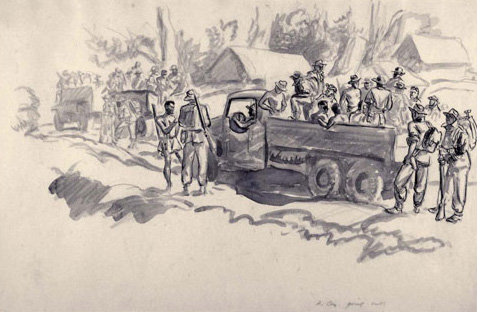
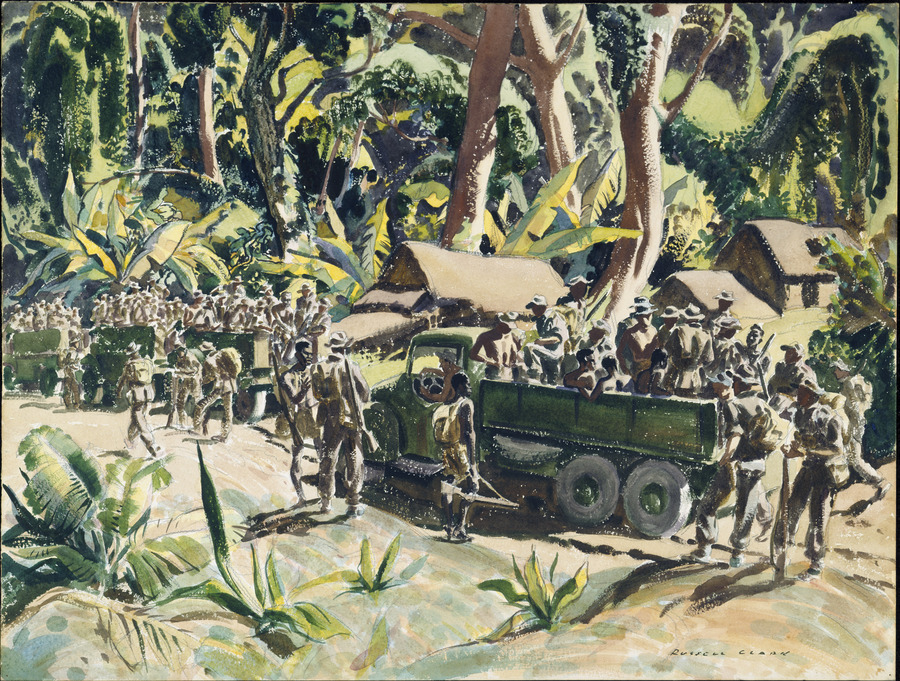
Another fine observational wash drawing (Figure 17) which was used as the basis for a final painting is “A-Company Going Out, Malsi” (Figure 18). Malsi was a village on the eastern side of Mono Island. A truck loaded with soldiers waits to go on patrol as their commanding officer talks to a native guide.
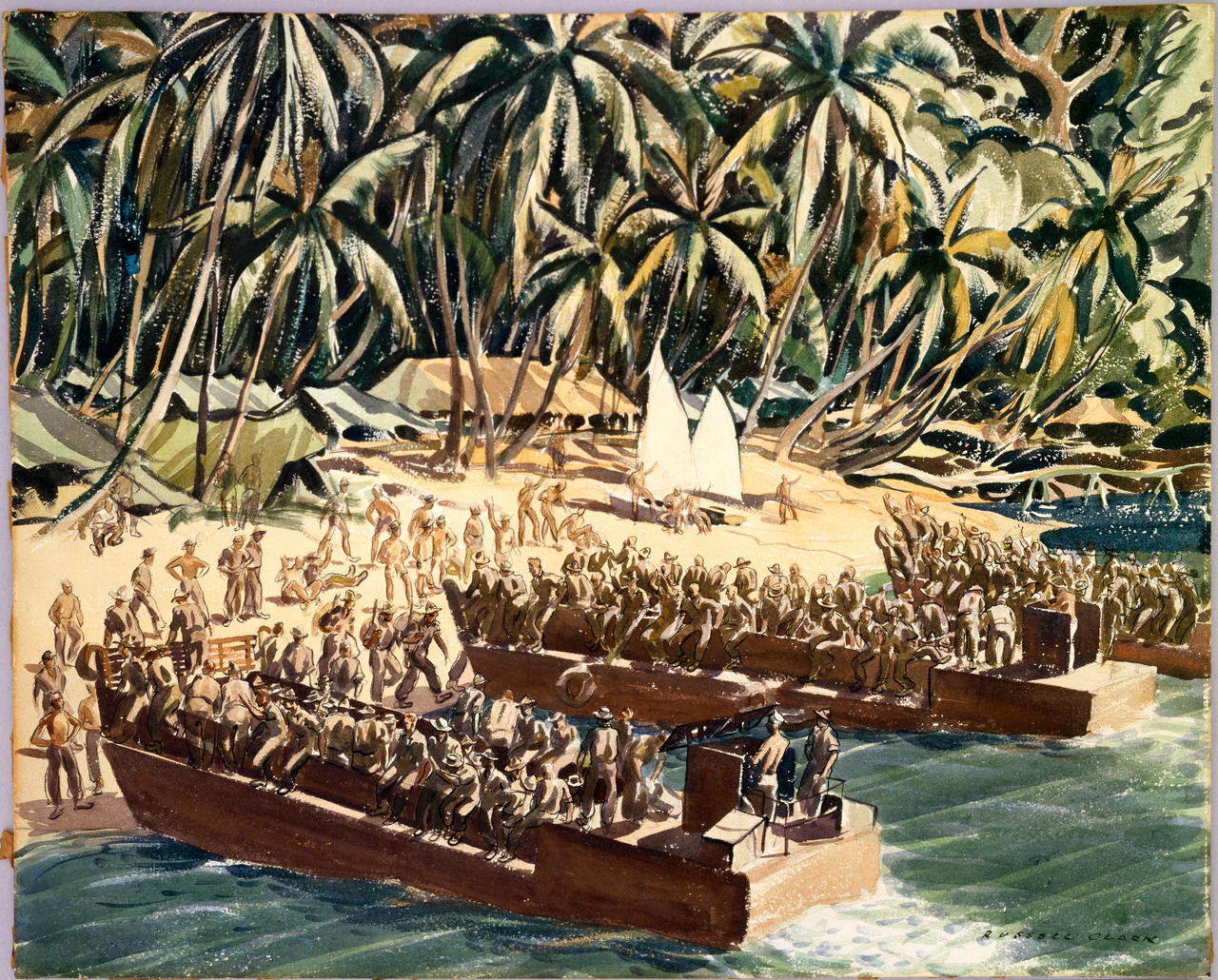
Interestingly, in a similar painting style, and from a similar viewpoint, Clark shows New Zealand troops being taken off the beach at the same location for the journey home in “First 300 Leaving Malsi for New Zealand” (Figure 19).
-
- Figure 17
-
- Figure 18
-
- Figure 19
Clark’s most well known war paintings are probably his more formal and interpretive works, most of which were completed back in New Zealand in the years following the war. He spent most of his time in the Pacific in the Solomons, so his major paintings are all set there.
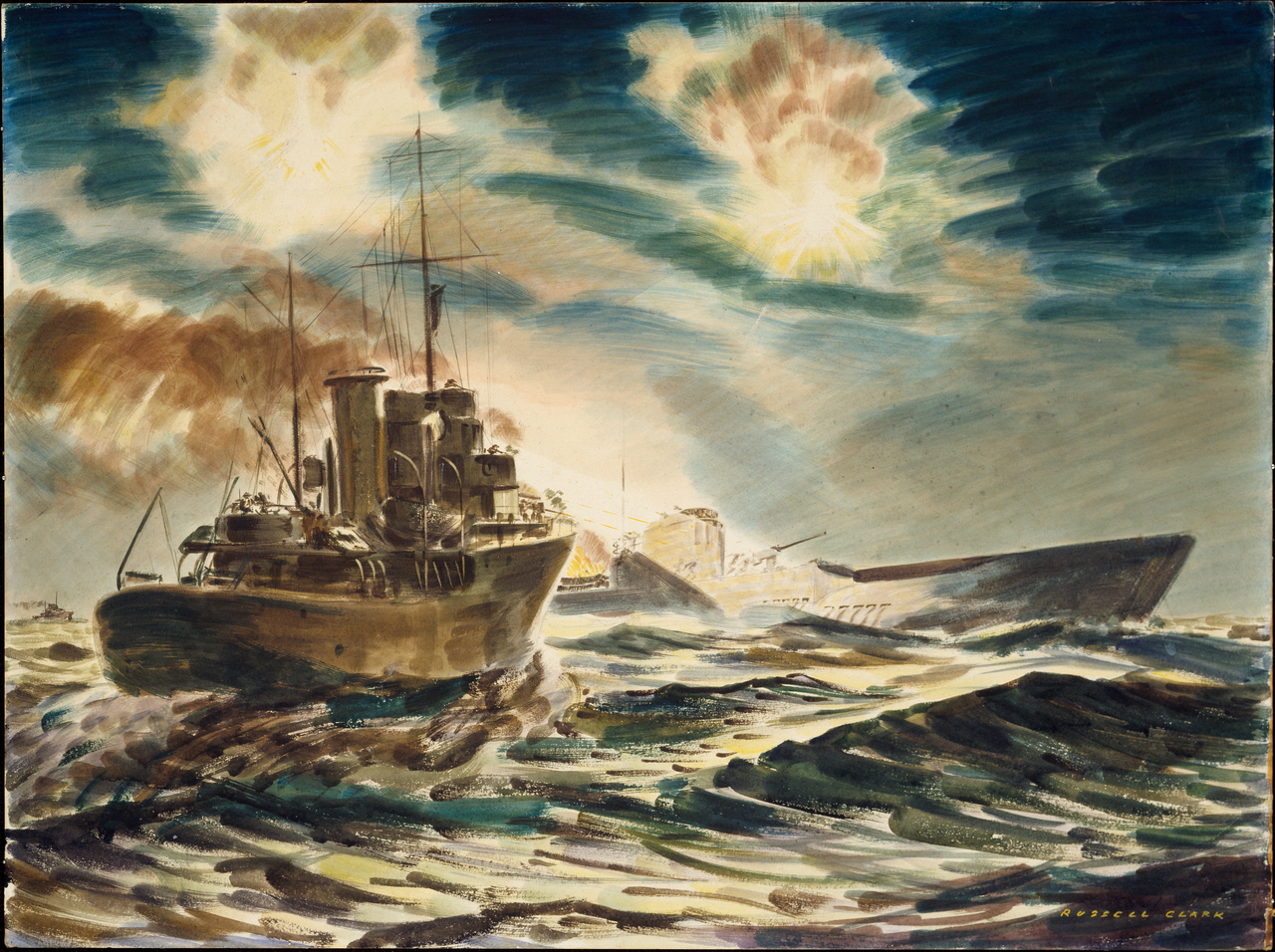
As a committed practicing painter he was interested in the work of the major artists of the time, especially those who had produced war-themed artworks. Their influence is apparent in some of his paintings. One example is “Night Action off Guadalcanal” (Figure 20) which depicts the famous ramming of a Japanese submarine on the night of January 29, 1943 by HMNZS Kiwi.
-
- Figure 20
-
- Figure 21
-
- Figure 22
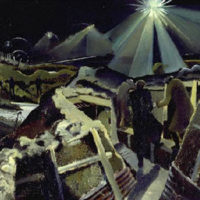
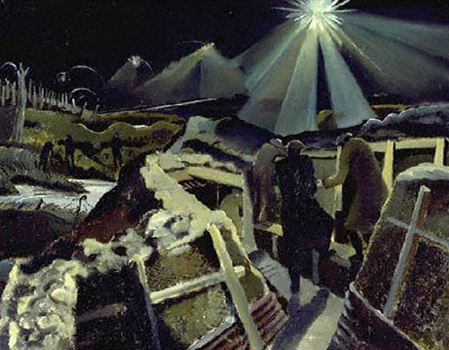
“Night Action Off Guadalcanal” is executed in a stylised manner with the subject dramatically backlit, similar to Paul Nash’s WW 1 work “The Ypres Salient at Night” (Figure 21). Clark seems to have adopted Nash’s approach in an attempt to dramatise the night fighting, albeit employing a more naturalistic painting style.
Harry Stone’s cousin Les Stone was among the crew and had given my father a tour of the ship a couple of weeks before the action depicted in Clark’s painting:
“Today I saw Les Stone off the N.Z. boat Kiwi. He met Rossie at Falamai and borrowed a canoe, then came over to this island. Cas and I went over to Falamai then caught the navy Liberty boat back to the Kiwi. She’s not a bad little tub – seems a bit small for these waters though.” – Thursday 13 January 1943.
(The former mine-sweeper had a displacement of 600 tons. In an ironic reduction of degrees of separation between my father’s experience and the fate of the planner of the attack on Pearl Harbour, a set of Japanese code books were discovered in the wreck of the submarine, which, when taken back to Pearl Harbour for analysis, enabled the Americans to intercept Admiral Yamamoto’s flight over Bougainville on April 18 1943, where he was shot down by a flight of P-38 Lightnings from Henderson Field.)
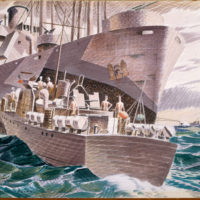
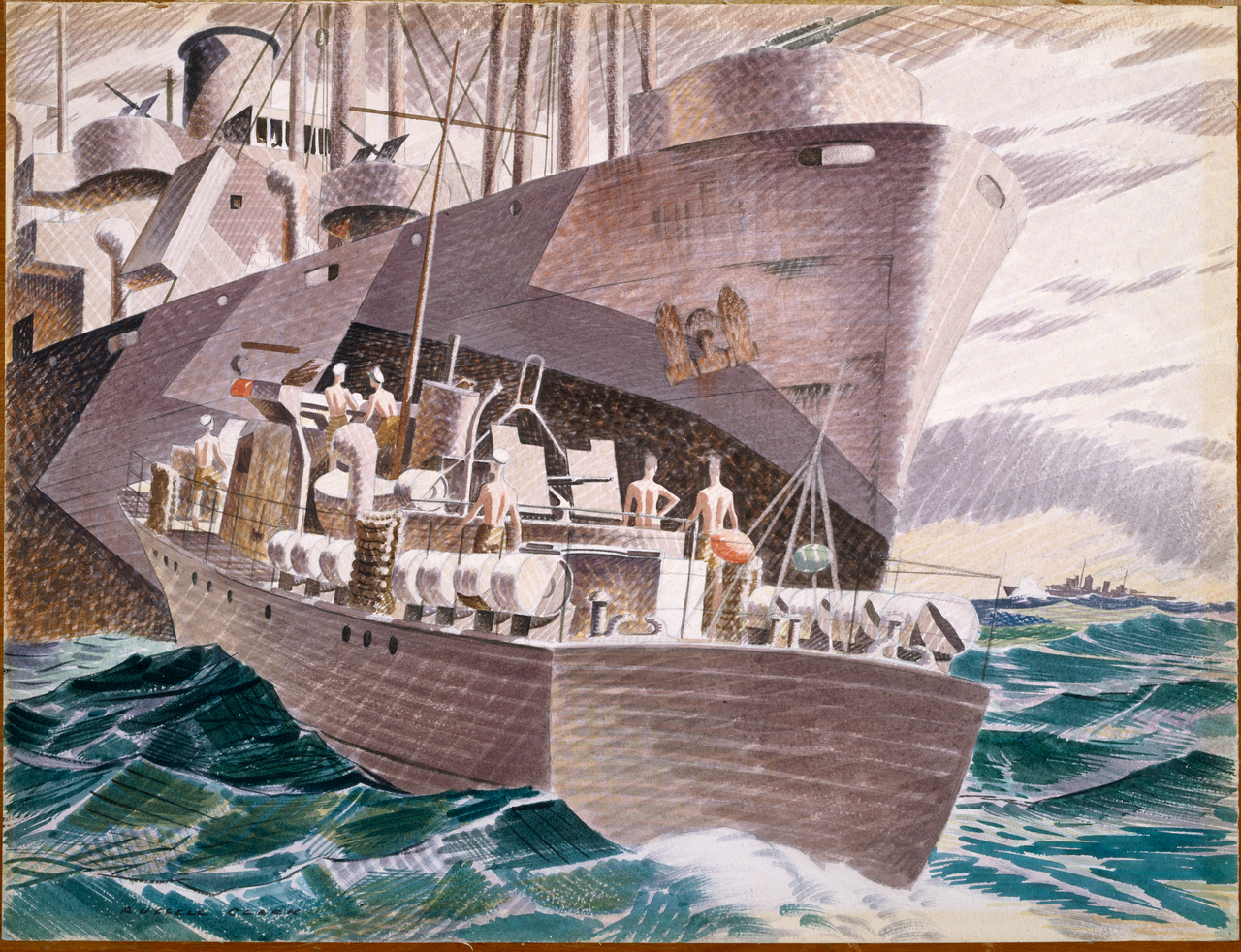
In a further representation of ships at sea, “Liberty Boats off Bougainville” (Figure 22), provides another example of experimentation and subtle abstraction, Clark using the geometric camouflage patterning on the hull of a Liberty ship as the starting point for a mildly cubist interpretation of a flotilla of boats at sea. Perhaps he was aware that these naval camouflage patterns were originally based on cubist paintings in World War 1. (During the First World War, Picasso is reported to have exclaimed to a companion as a camouflaged artillery piece was being towed by: “We did that!”)
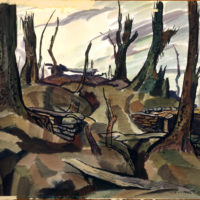
Another, perhaps more obvious example of Paul Nash’s influence is to be seen in Clark’s “Battleground Scene” (Figure 23), a generic, timeless scene of a bombed out landscape, which could be from the Western Front in 1914 or equally a scene on Guadalcanal. It has clearly been modelled on Paul Nash’s WW1 painting “We Are Making a New World” (1917-18) (Figure 24), in general composition, back-lighting producing silhouetted, blasted trees, and a stylised technique.
-
- Figure 23

-

- Figure 24

Upon his discharge from the army in 1946 Clark returned to Christchurch where he took up a teaching position at his old school, the Canterbury College School of Art. He continued to produce illustration work and to exhibit paintings in the 1950’s and became interested in sculpture and public artworks. He returned to producing illustration work for the New Zealand Listener and the School Journal.
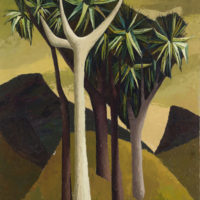
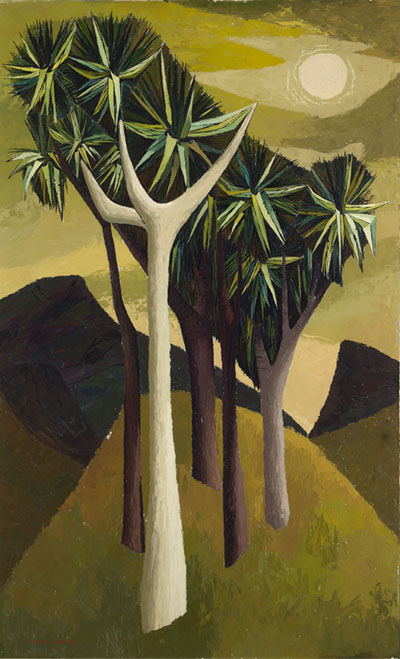
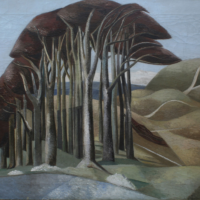
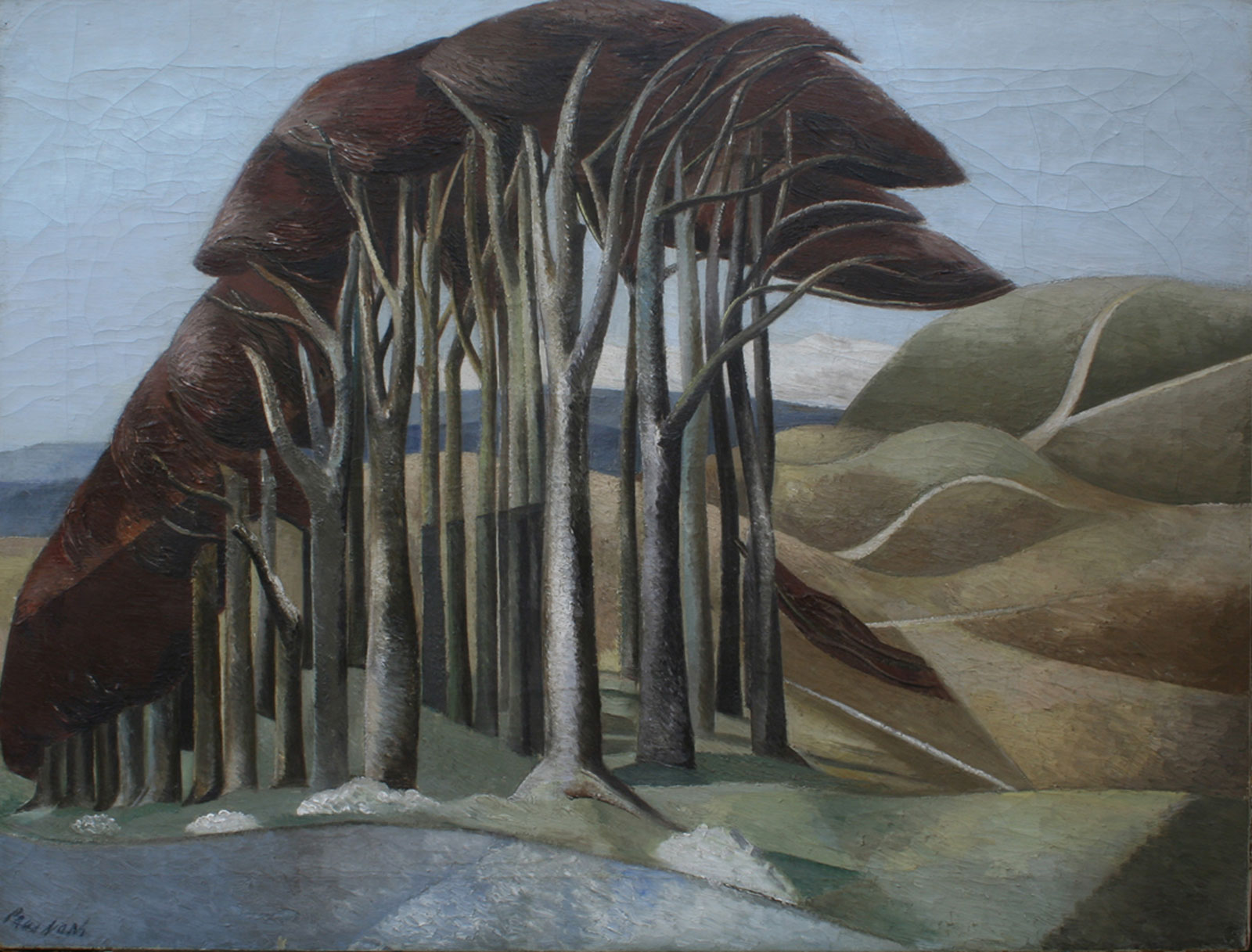
Clark produced a series of modernist semi – abstractions based on the humble cabbage tree (Figure 25). The influence of his painting idol Paul Nash’s style is still very evident in these works (Figure 26) .
-
- Figure 25
-
- Figure 26
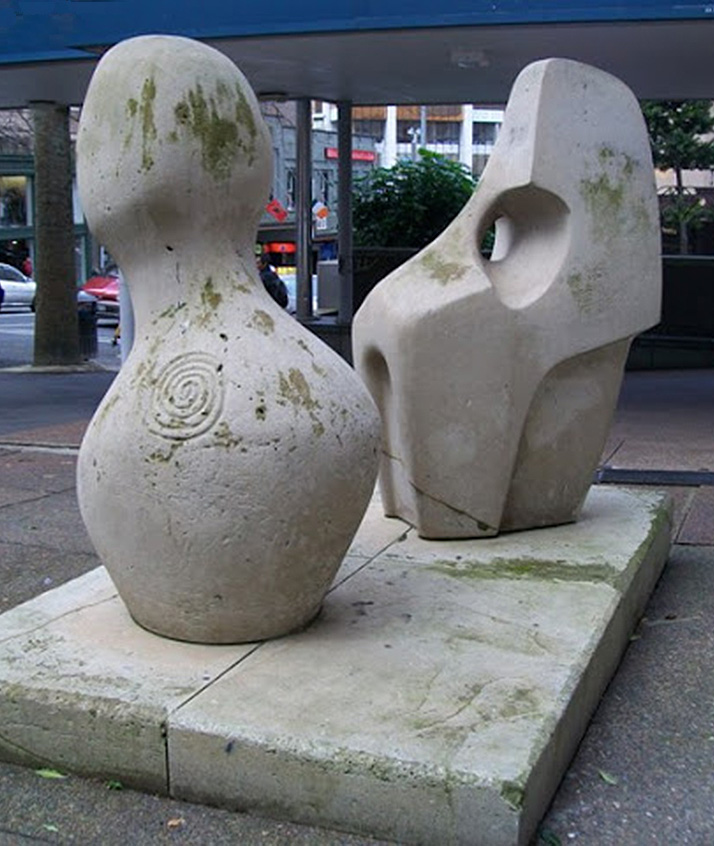
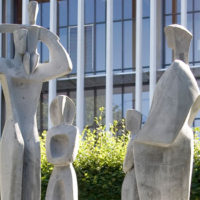
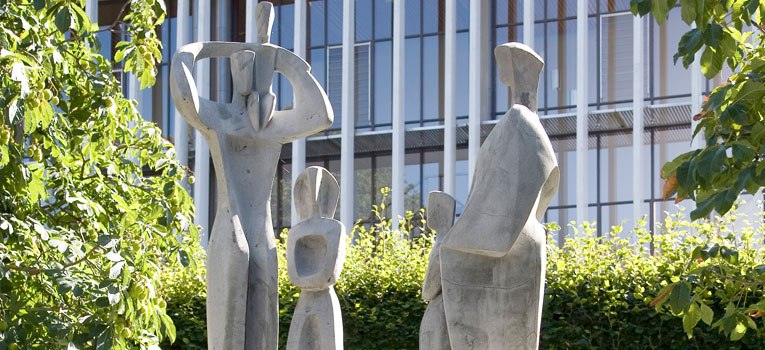
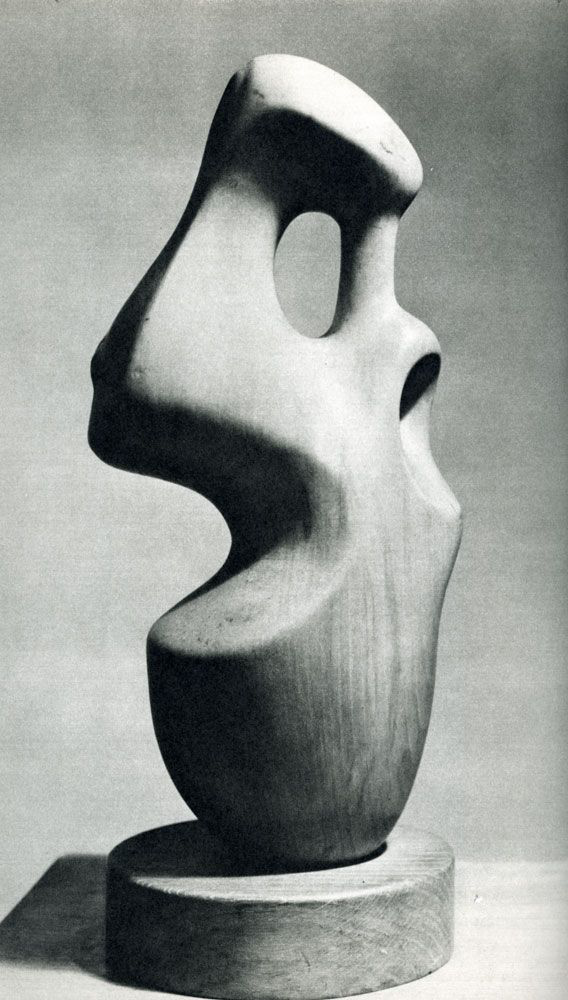
Although Clark was well known as an illustrator and painter, he was commissioned to produce several sculptures in the years after the war. Among these works were two modernistic anchor-stone sculptures for the Bledisloe Building in Auckland in 1959 (Figure 27), based on the shape of traditional Maori anchor stones, and “Family Group” for the Hays Shopping Centre in Christchurch, now displayed at Canterbury University(Figure 28), Both of these works show the influence of British sculptor Henry Moore (Figure 29), both in the human form, family based subject matter with organic shapes and pierced and hollow spaces.
-
- Figure 27
-
- Figure 28
-
- Figure 29
One of his last three dimensional works was a monument to Opo the Dolphin at Opononi in the Far North of New Zealand in 1960 (Figure 30).
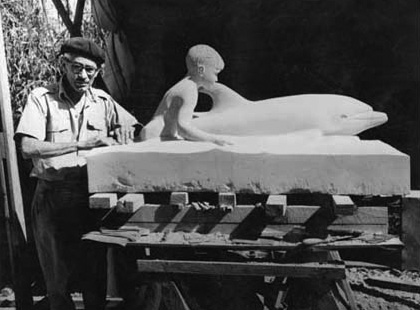
Figure 30
Russell Clark died in 1966. He was an important, under-rated and prolific New Zealand artist. Many of his war paintings can be viewed at the New Zealand Archives website:
http://warart.archives.govt.nz/RussellClark