Figure 1
By definition, any art not created by the three official war artists In the Pacific was unofficial art, but this does not mean that the quality or significance of such art was any less than that produced by the commissioned artists.
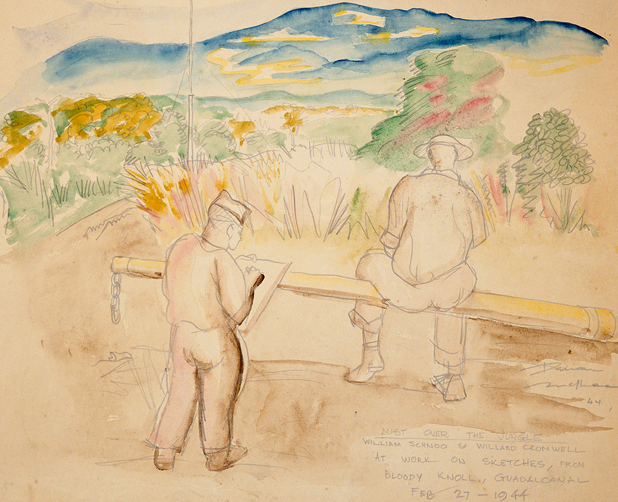
Many formally trained and practicing artists went to the Pacific War (as well as naturally talented amateurs). Although conditions often made carrying a set of brushes and paints (let alone restocking them as they wear out or dry up or tubes burst in the heat) very difficult for enlisted men, they felt compelled to continue making art in the face of war. They sought to respond to and record their changing environment and circumstances, or perhaps simply wanted to ‘keep their hand in’ until their return to civilian life (which for many included professional art teaching). Some servicemen spent time drawing as a form of relaxation (Figure 1).
The art training and knowledge of contemporary or recent trends and developments in the visual arts is often apparent in the styles of these artists. For example James Coe demonstrated an awareness of the German Expressionist movement in his graphic, often shocking war imagery.
Some of William Reed’s work showed the influence of the Surrealist movement, as did official artist Alan Barns-Graham, who also demonstrated an interest in the vivid colouration of the paintings of Rousseau in his representations of lush jungle scenes.
There were opportunities for talented soldiers to exhibit and/or publish art works produced during wartime in the Pacific, especially as the war wound down and more time became available for private pursuits. Even for those on the far-flung Treasury Islands, where Harry Stone was based in 1943-44, exhibitions of art and craft work were organised in the village of Falamai, and there was a workshop and tools for making art works (presumably advice and training as well) at the base at Malsi on the east coast of Mono. Occasionally art competitions were organised to encourage the men to get involved in art production in a range of media.
Artwork was sometimes published in the service newspaper the ‘Kiwi’ and “Korero” magazine produced by the Army Educational and Welfare Service (A.E.W.S.)
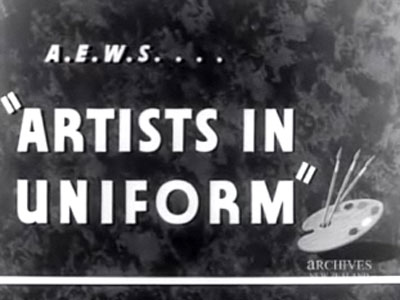
“Artists in Uniform” was an exhibition of soldier art by New Zealand and American servicemen organised by the A.E.W.S. which toured New Zealand in 1944 and was shown in the major centres (Figure 2). Five hundred submissions were made from which the exhibition was selected. Money raised from the sale of works was donated to the Patriotic War Fund.
-
- Figure 2
-
- Figure 3
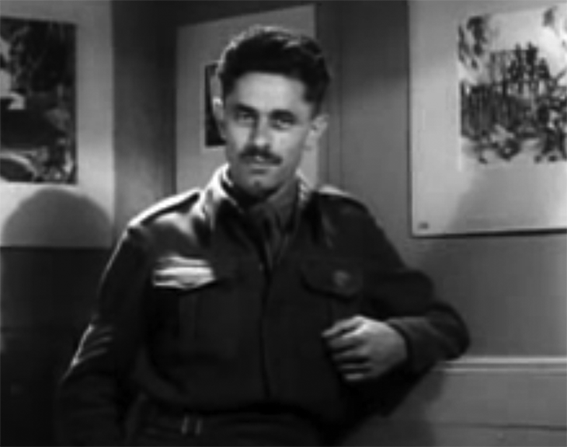
A short documentary by the National Film Unit was produced about the exhibition featuring Russell Clark, in uniform, talking about the show (Figure 3):
http://audiovisual.archives.govt.nz/wiki/index.php/WEEKLY_REVIEW_No._133
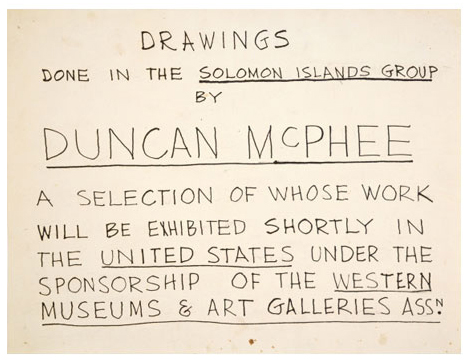
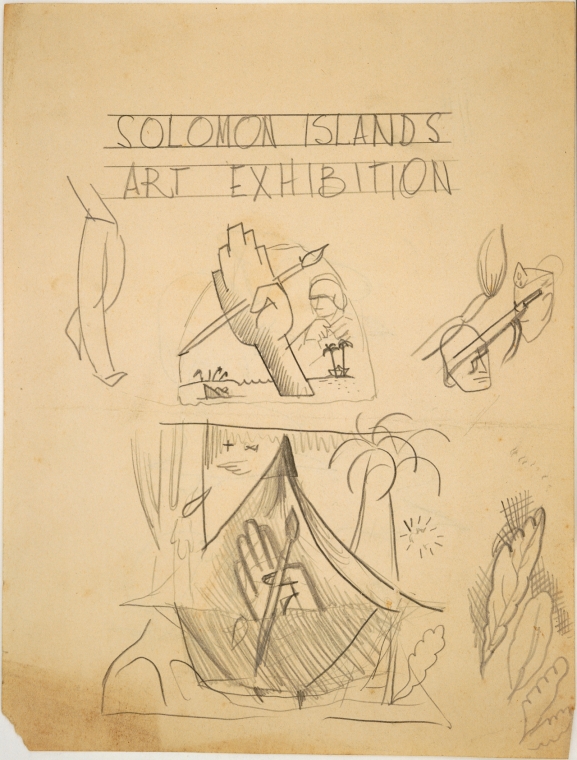
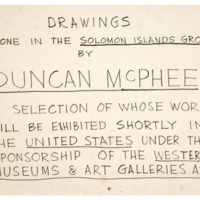
Duncan McPhee produced a catalogue for an exhibition of his work which was apparently shown on the West Coast of America (Figures 4 and 5). No confirmation of this claim has become available to date.
It could be argued that the work of these trained and talented artists, unencumbered by any official pressure to create images which are acceptable to the military hierarchy in support of the war effort, demonstrates a higher level of autonomy and integrity, and possibly greater creativity and experimentation, than that of their official counterparts.
-
- Figure 4
-
- Figure 5