
Figure 1
Harry Stone had an interest in art from a young age and clearly had a strong drawing ability. In this he appears to have followed in the footsteps of his own father, Harry Osburne Stone Senior (Figure 1). Harry Senior served with the New Zealand branch of the Royal Australian Navy in World War 1. New Zealand did not have its own navy at the time.
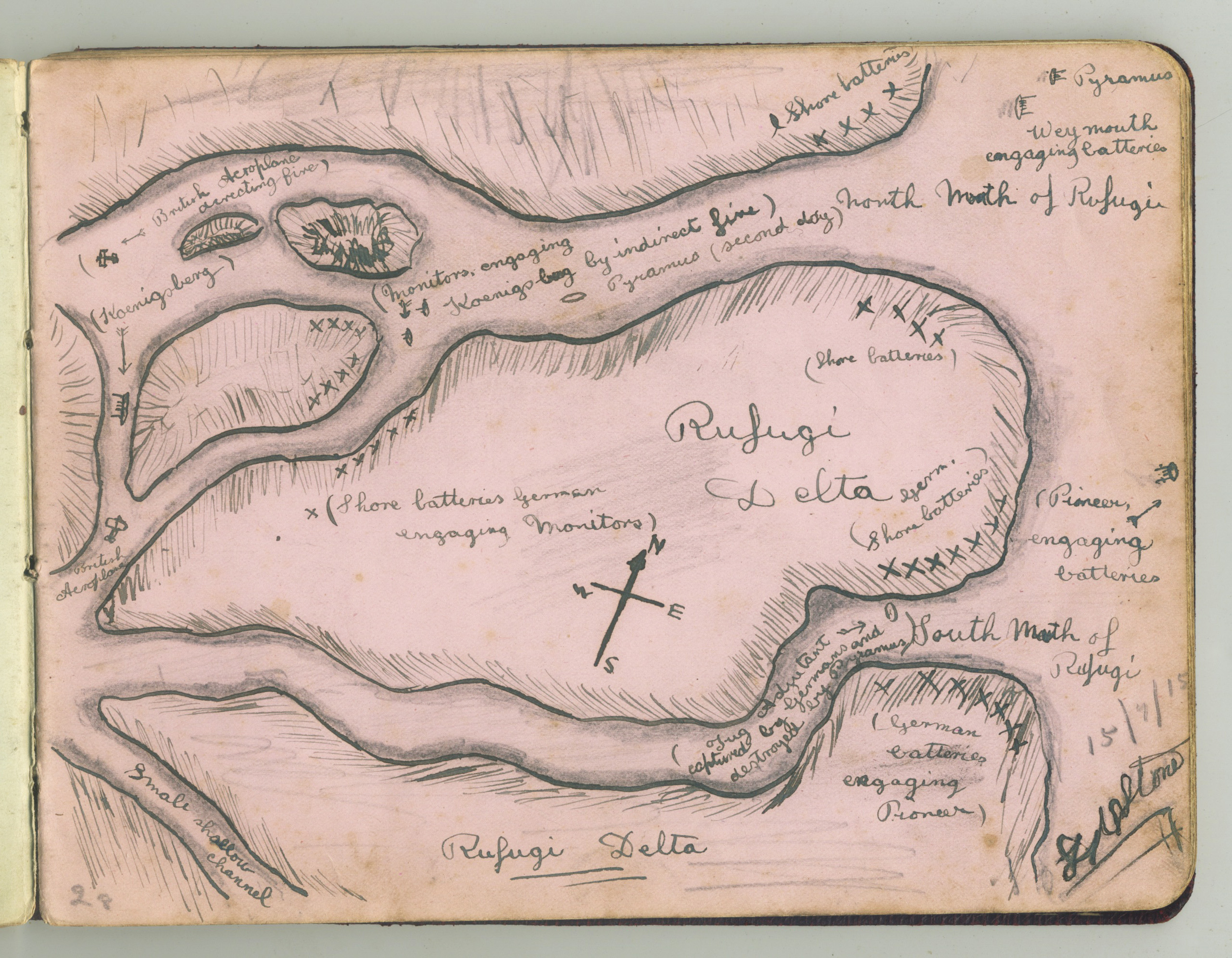
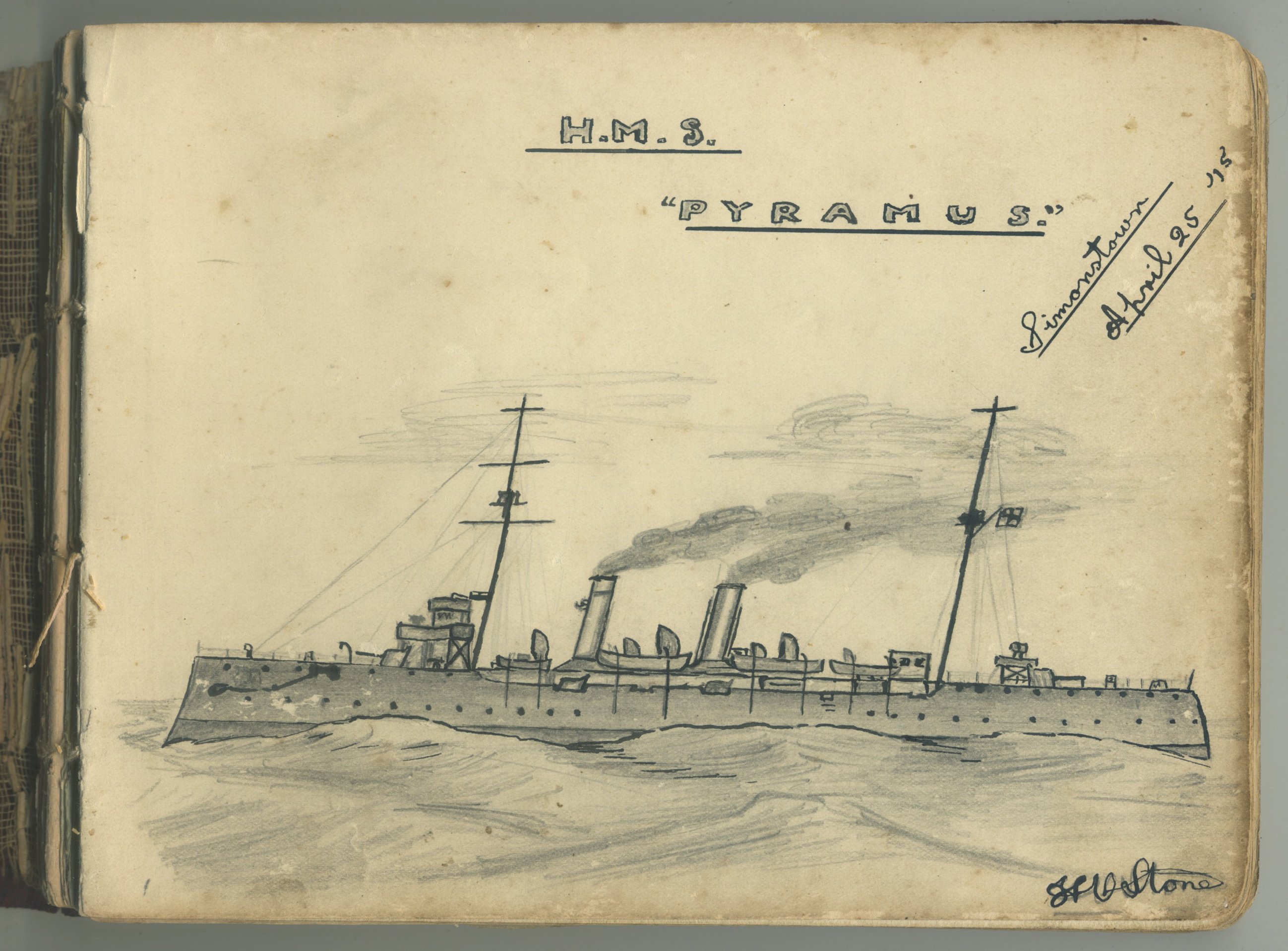
During the 1914-18 war he served in the warships New Zealand, Pyramus,and Doris. It was while he was serving on the HMS Pyramus that she became involved in the Koenigsberg incident in July of 1915, when the German cruiser was blockaded and scuttled on the Rufiji River delta in what was at the time German East Africa: present day Tanzania.
He was a powerful swimmer and could reportedly swim under the hull of his ship from one side to the other. Harry Senior was awarded the Royal Life Saving Society’s Medal in 1933, for saving a man who was being swept out to sea at the mouth of the Wade River, north of Auckland.
Between the two Worlds Wars he operated a timber-milling business in Warkworth and Mangawhai areas in New Zealand’s Northland (my father learned timber-milling from him and worked in a saw-mill in West Auckland for a time after being discharged from the army).
He was also a prolific “bush poet”, producing a solid body of well written (if self-admittedly doggerel) poetry which serves to shine a fascinating light on the sailors’ and pioneer working-mens’ lifestyles in New Zealand’s colonial period.
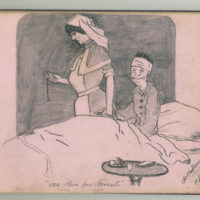
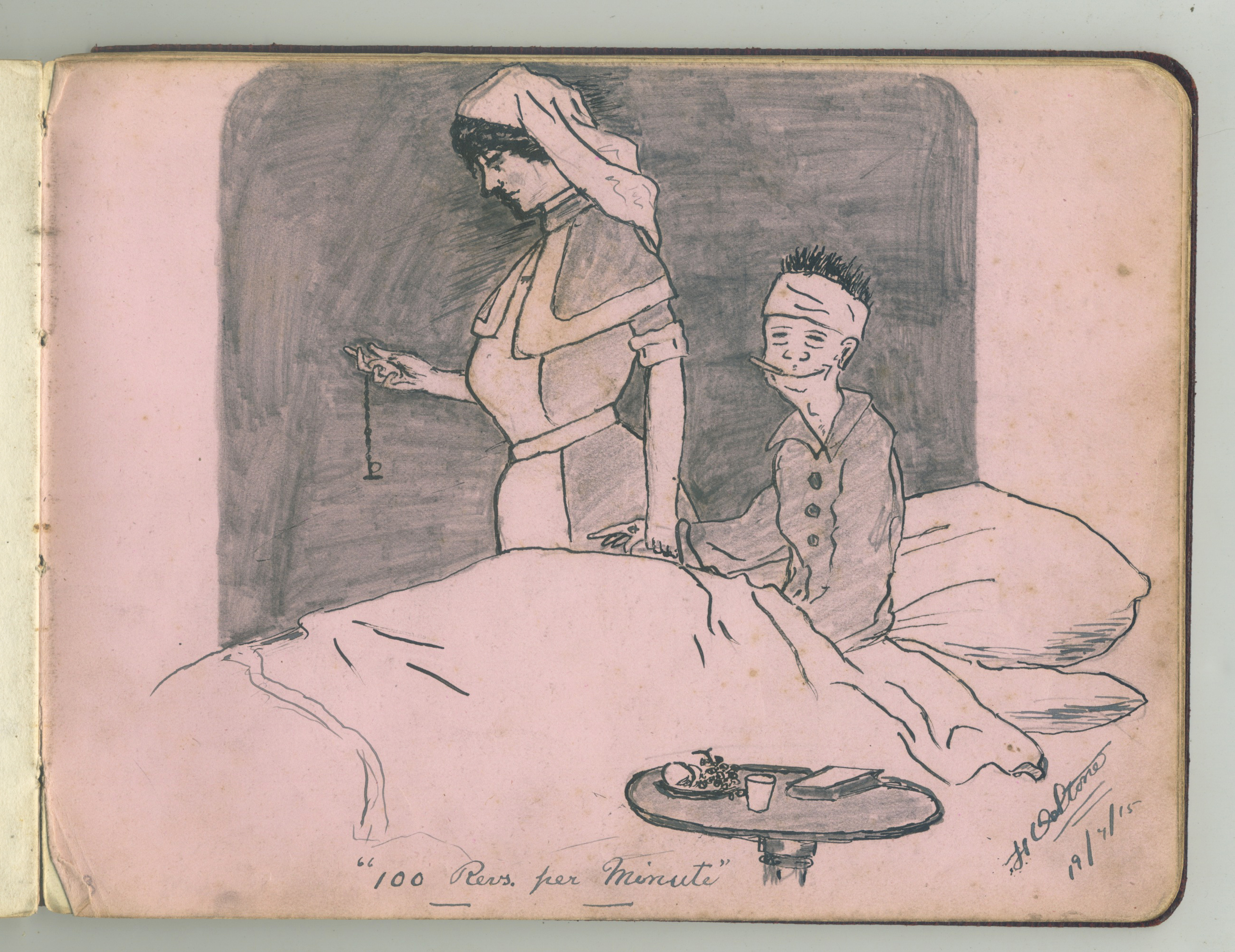
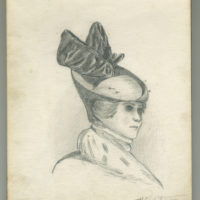
Like my father, Harry Senior had strong drawing skills although there is no evidence of either man ever taking up a paint brush. He took a sketch book with him on his travels with the navy and filled it with pencil drawn cartoons, portraits, drawings of ships and boats (Figure 2 – 4). It is likely that many of these drawings were copies of other artworks or based on photographs.
-
- Figure 2

-
- Figure 3
-
- Figure 4

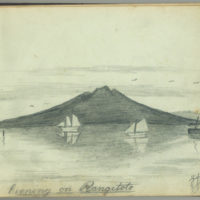
Interestingly, the sketchbook contains a detailed hand drawn map showing the positions of the ships involved in the Koenigsberg affair (Figure 5). There is also a sketch of his ship HMS Pyramus, as well as a drawing of Rangitoto, “Auckland’s sacred island” which was to welcome my father home in the last paragraph of his war diaries.
-
- Figure 5
-
- Figure 6
-
- Figure 7

In the mid 1930s Harry Stone Junior enrolled in the Brodie Mack Correspondence Art School. This institution was based in Sydney but was founded by Brodie Mack, a draughtsman and cartoonist originally from Wellington. The art school offered training and assessment by correspondence and was advertised in newspapers and magazines throughout Australasia in the 1930s and 1940s (Figure 8).
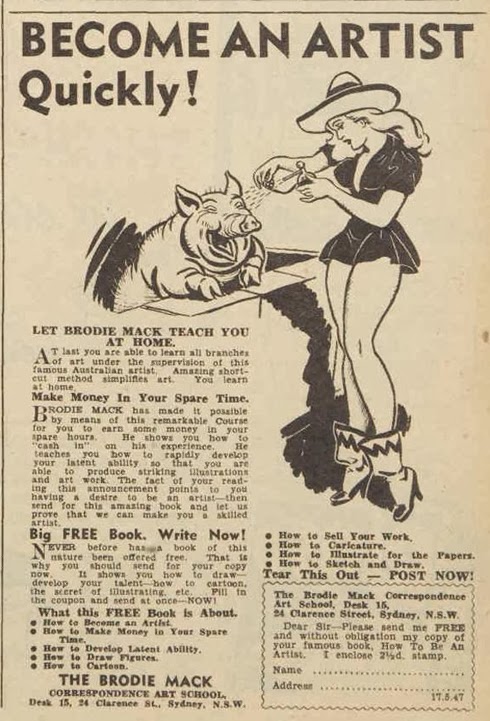
Figure 8
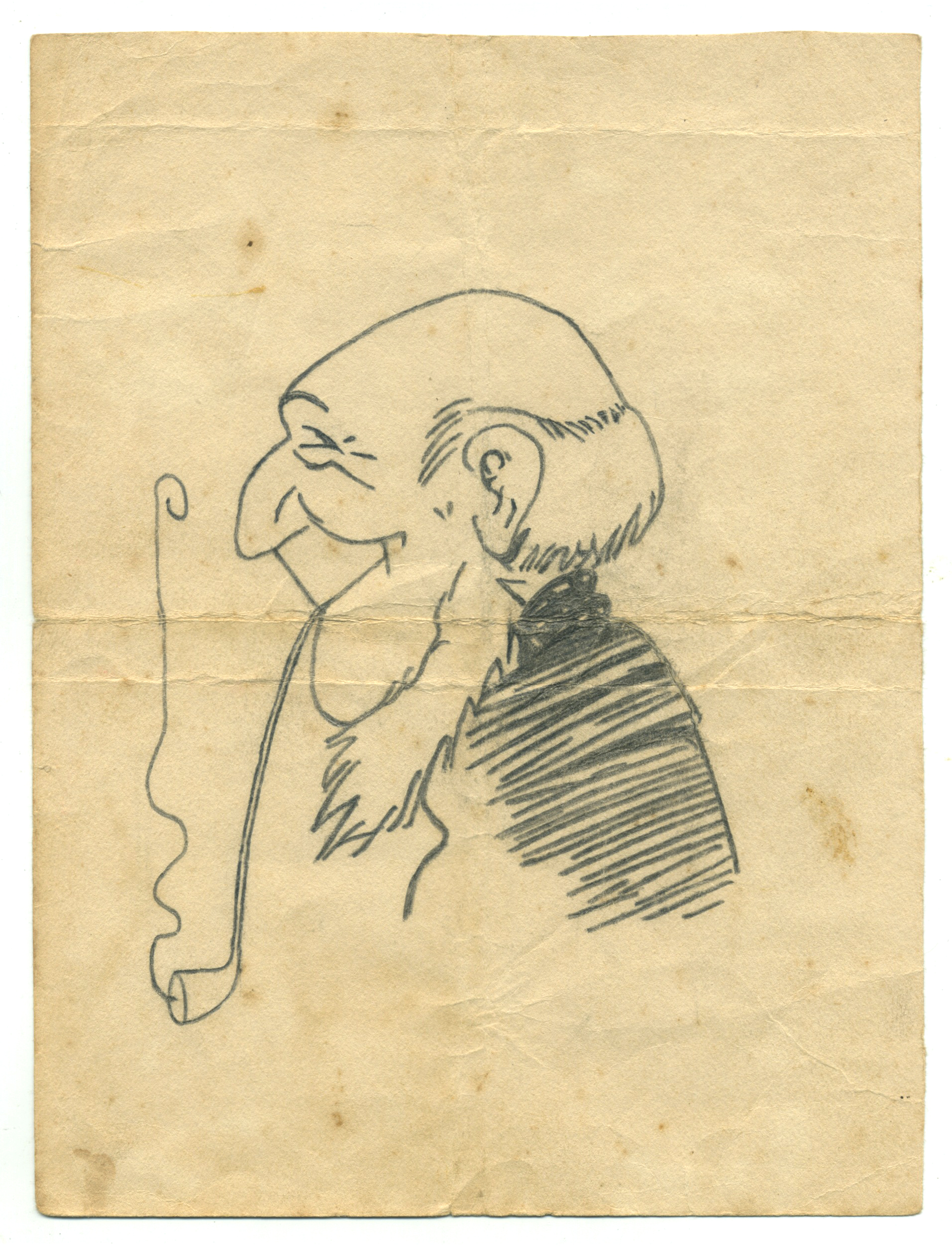
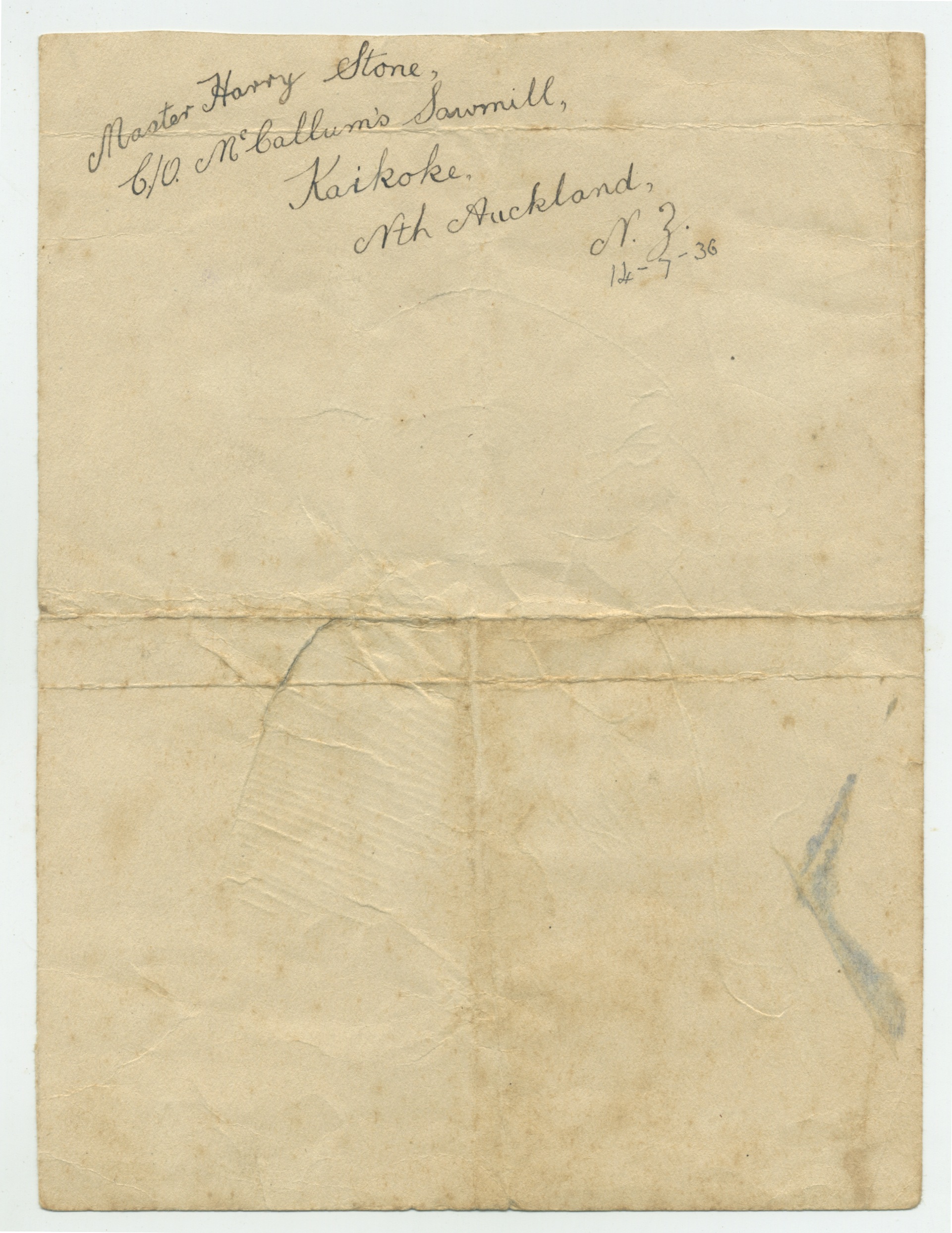
There was a strong emphasis on cartooning. Harry’s drawing of an old man with a pipe (Figure 9) appears to have been submitted for the course. On the reverse is his hand-written return address at a sawmill in Kaikohe, dated 14 July 1936. Harry would have been sixteen at the time (Figure 10). The address includes NZ at the end, confirming that the drawing was most likely sent overseas for assessment. The drawing is creased across the middle, suggesting it has been folded before being placed in an envelope prior to being sent for assessment to the art course in Australia.
-
- Figure 9
-
- Figure 10
His work was obviously of an acceptable standard and he was awarded a certificate from the art school, dated 11 January 1940. Dad was nineteen.

Figure 11
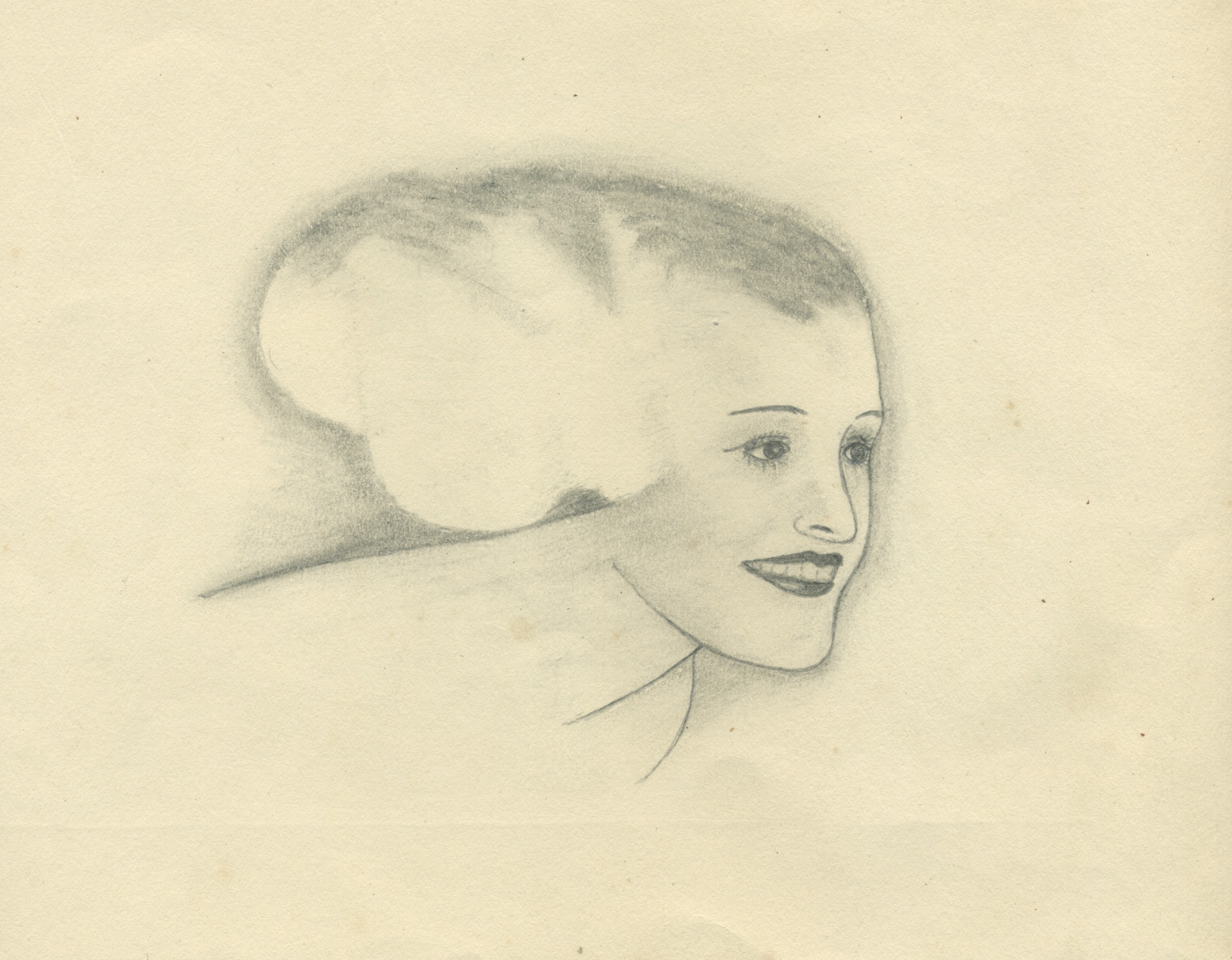
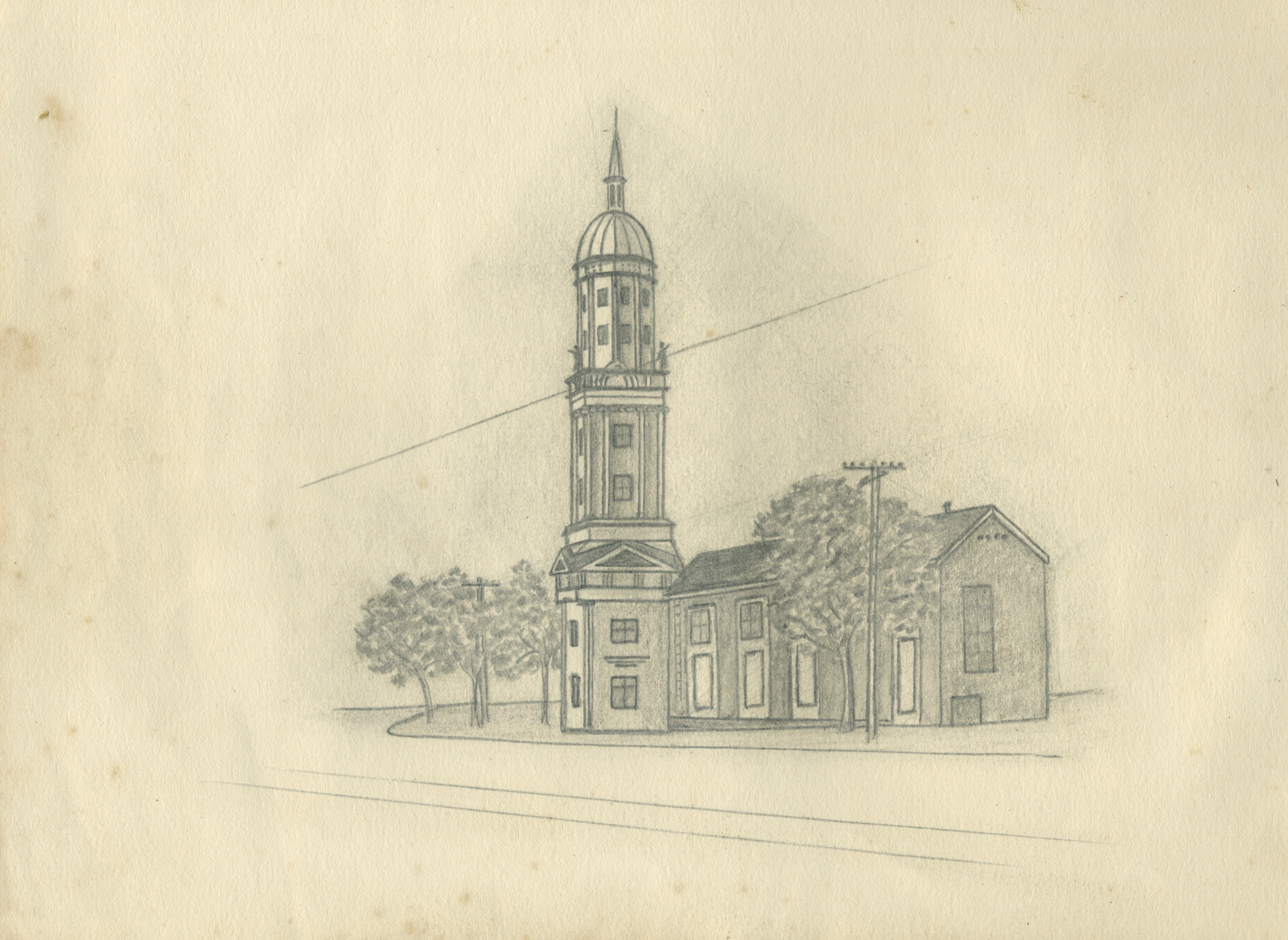
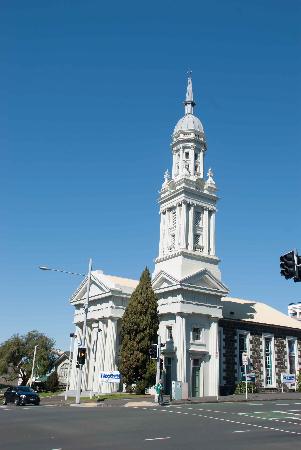
Harry’s sketchbook contains several pre-war drawings and cartoons. There is a sketch of a very 1930s looking woman, possibly from a photograph of a Hollywood movie star of the time (Figure 11), and a detailed representation of what appears to be St Patrick’s Church in Symonds Street, Auckland (Figure 13 and 14), also most likely based on a photograph. The emphasis appears to have been on accuracy and toning control in these drawings, consistent with the kind of disciplined rendering usually expected in art courses of this type.
-
- Figure 11
-
- Figure 13
-
- Figure 14
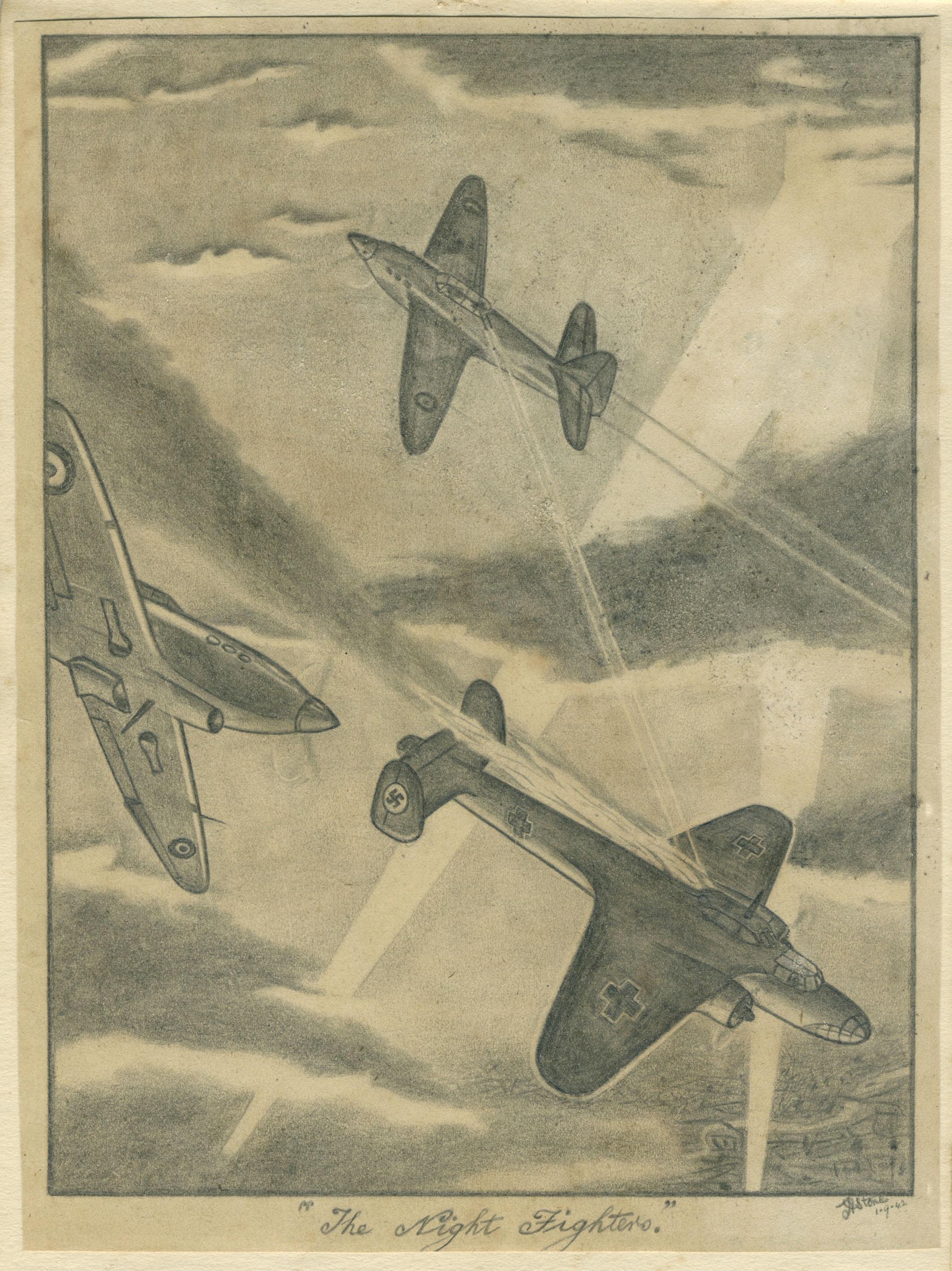
As the War in Europe unfolded, Harry’s drawings reflected his impressions of the war in the air. Here also the drawings are most likely based on photographs or other illustrative work. His drawing technique continued to be centred around accuracy and dense toning. The drawings of a pair of RAF night fighters shooting down a German bomber (Figure 15), and a Bristol Beaufighter attacking a German ship (Figure 16), Nazi Swastika clearly fluttering from the stern, are particularly good examples of his skill with a pencil. These drawings, which I remember admiring and being mystified by as a very small boy, are impressive examples of my father’s ability with a tonal pencil and eraser at this young age.
-
- Figure 15
-
- Figure 16
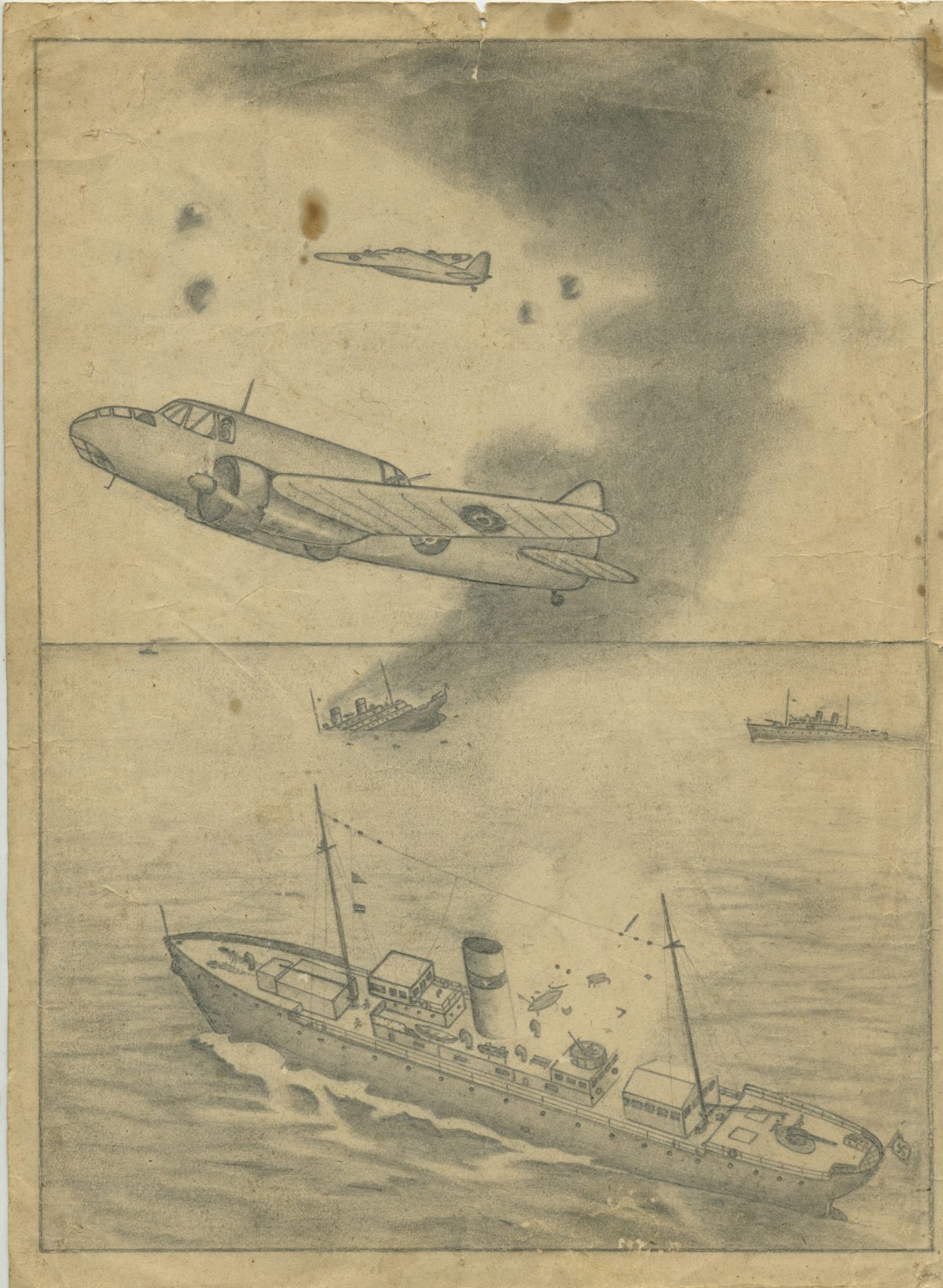
With allegiance to the “Mother Country” running highly, and at a time when the future of the British Isles was still very much in the balance, both of these drawings illustrate the Germans being soundly beaten by superior British aerial technology. These drawings were made in September 1942. Harry was shipped overseas in February 1943.
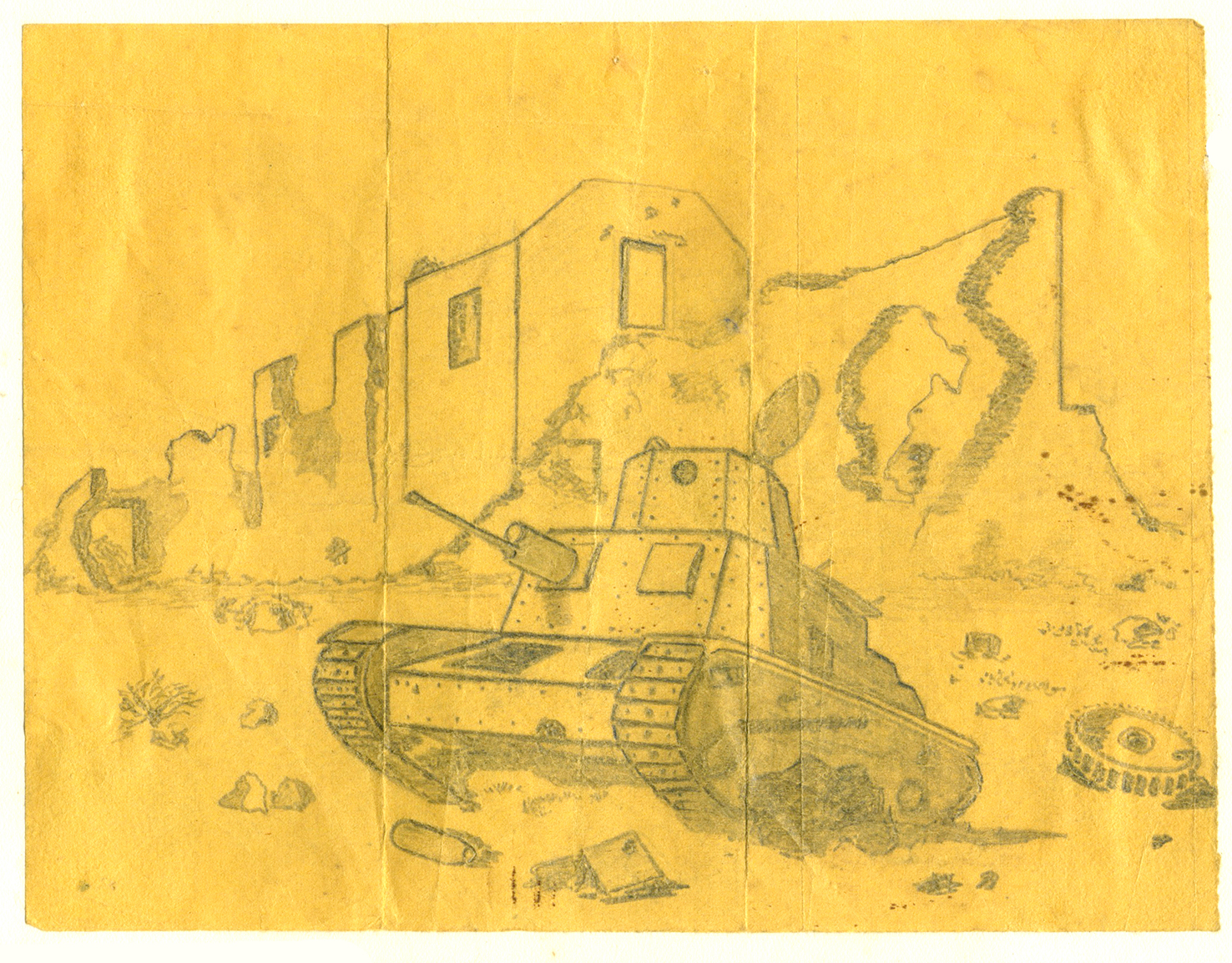
A drawing of an Italian tank continues Harry’s interest in contemporary war machinery (Figure 17). It is interesting to note that Harry applied to take an aircraft mechanics course while in the army, but to his great disappointment, was rejected. In his war diary, he also expressed a passing interest in training as a tank driver when he saw some British manufactured New Zealand Army Valentine tanks in New Caledonia.
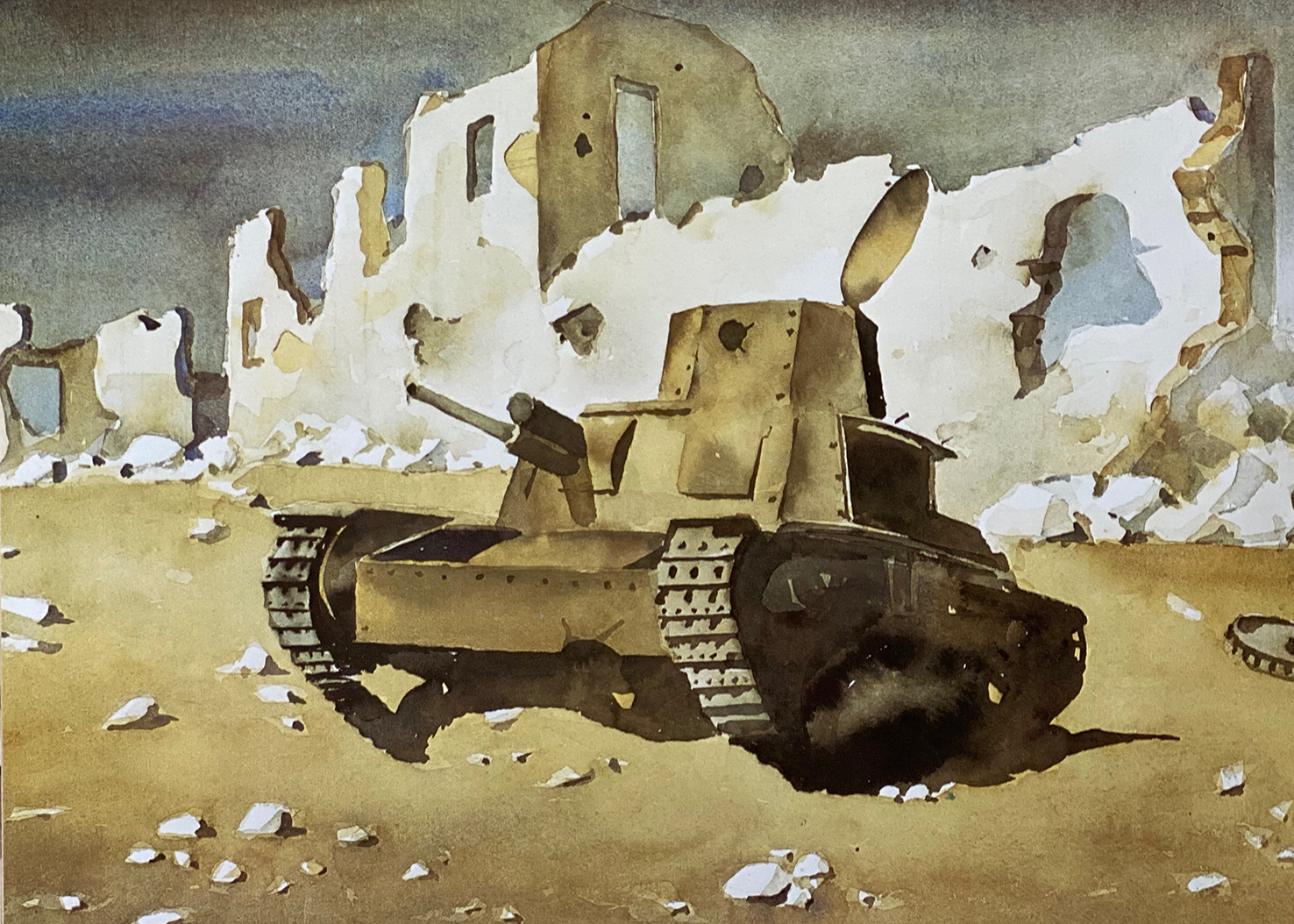
This drawing is a copy of a painting of a destroyed Italian tank following the Battle of Sidi Barrani in Northern Africa in December of 1940, by the official New Zealand war artist Peter McIntyre (Figure 18). The battle saw the rout of the Italian forces by the British. The tank appears to be a Fiat m11/39 (Figure 19).
-
- Figure 17
-
- Figure 18
-
- Figure 19
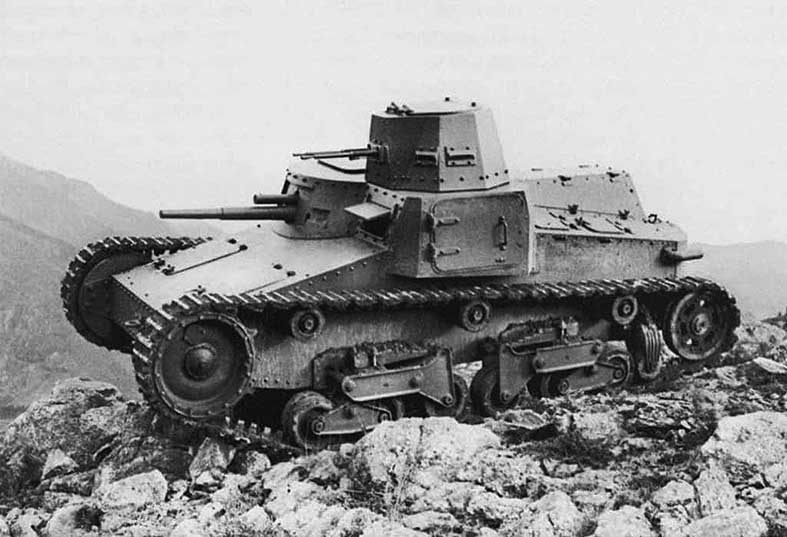
Harry’s drawing is a very accurate translation of the painting. The top of the tank is in a slightly different position in relation to the ruined buildings in the background, and my father has added an artillery shell and a few other objects in the foreground, but all of the other details have been faithfully recorded.
There is no date on the drawing, but it must have been made soon after my father was conscripted into the NZ Army. He was 20 years old when the Battle of Sidi Barrani took place and he had entered “permanent service” in 1939.
Where he first saw the image is a mystery. The book containing McIntyre’s painting was not published until well after the war. Perhaps it had been reproduced as a newspaper illustration soon after the battle occurred.
Like his father, Harry Stone kept a sketchbook with him during his time overseas. Although he doesn’t appear to have been as prolific as his father, preferring to devote time to his diary upkeep, their drawing style is quite similar, using a soft 4B or 6B pencil to produce soft, dense tones and attention to a sharp edge and clean detail.
When my father was sent to the war zone in the Pacific Islands, he continued for a time to use his drawing activities to record his experiences and things of importance around him. As mentioned in the section covering his “Diary No 1”, he drew the Amedee Lighthouse from the troopship on the way into Noumea Harbour, and made a lovingly detailed drawing of his Ford army truck, shown here (Figure 20).

Figure 20
His talents were soon put to other uses. He was called on to paint the 54th Anti-Tank Battery insignia on a variety of military vehicles while still in New Caledonia, but he seemed to loose interest in drawing for the sake of it.
His drawing while stationed on Stirling Island seems to have consisted mostly of cartoons for the 54th Anti-Tank Battery Christmas dinner menu and a Christmas card for his mates, who didn’t like the official one issued to the troops because it depicted an illustration of a New Zealand soldier wearing American kit, by Offical War Artist Alan Barns-Graham (refer to “Diary No. 2 Part 3” in this website).
Apart from these cartoons there is no evidence that Harry was to continue with his drawing. He did not demonstrate the ongoing dedication for the medium or interest in visually recording his experiences that other servicemen did.
Rather, he began to make three dimensional models from spent cartridge bullet and artillery shells, as mentioned in the notes in “Diary No 2 Part 3”. With the American Construction Battalion (C.B. hence Seabee) installation at the nearby Stirling airstrip he had access to tools and equipment to produce these three dimensional objects. The problems for Harry that arose from this pursuit, including the threat of court martial, are also described in the same section of his diary.
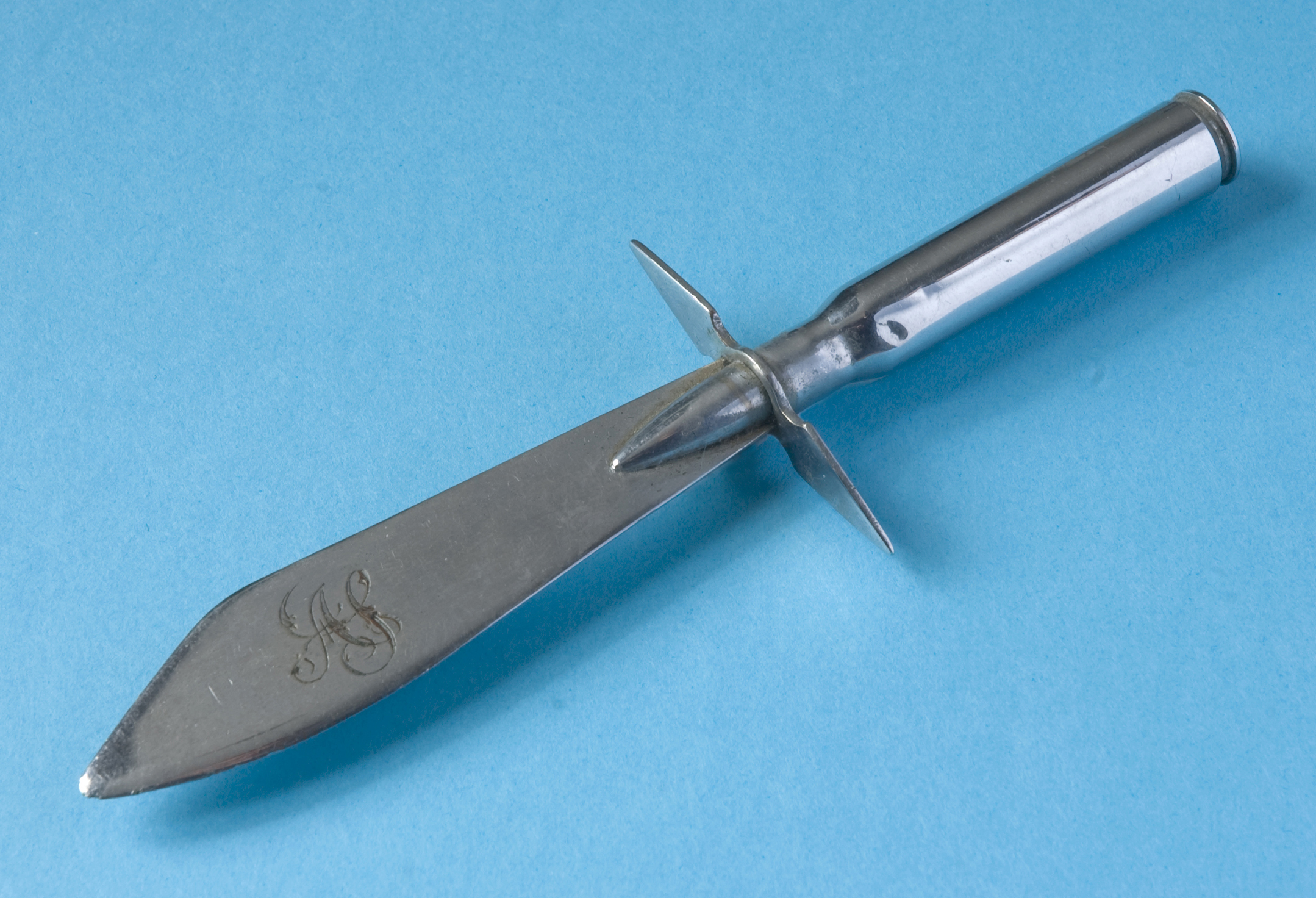
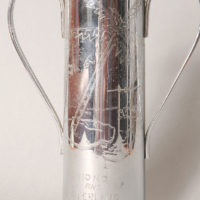
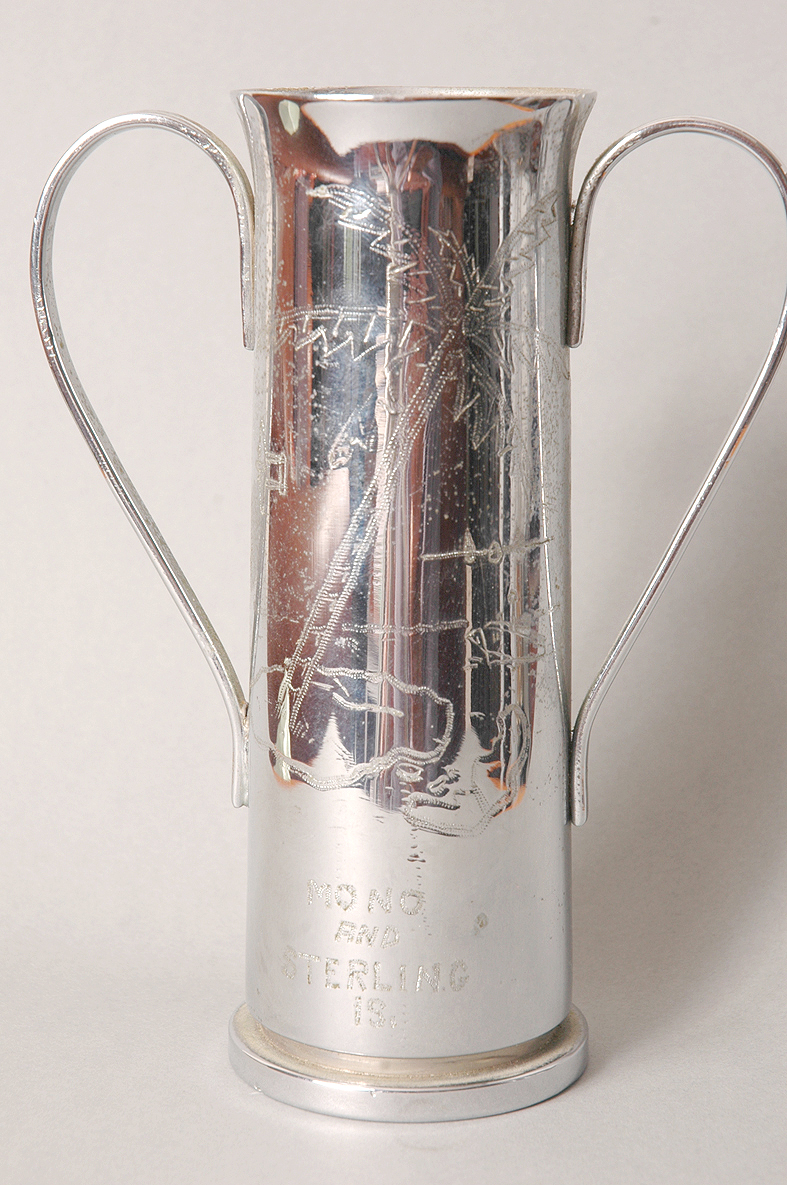
We cannot know what order these works were created in, but it’s fair to assume that the simplest ones came first: a letter-knife (Figure 21), carefully engraved with my mother’s initials: an A and S for Adele Stone. The vase is from a spent anti-aircraft shell (Figure 22). It is engraved with images of a coconut tree sprouting from island map-shapes clearly recognisable as Mono and Stirling as well as a P38 aircraft and a warship. On the verse side is a list of all of the places he visited: New Caledonia, Efate, Guadalcanal and the Treasury Islands.
-
- Figure 21
-
- Figure 22
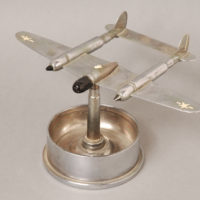
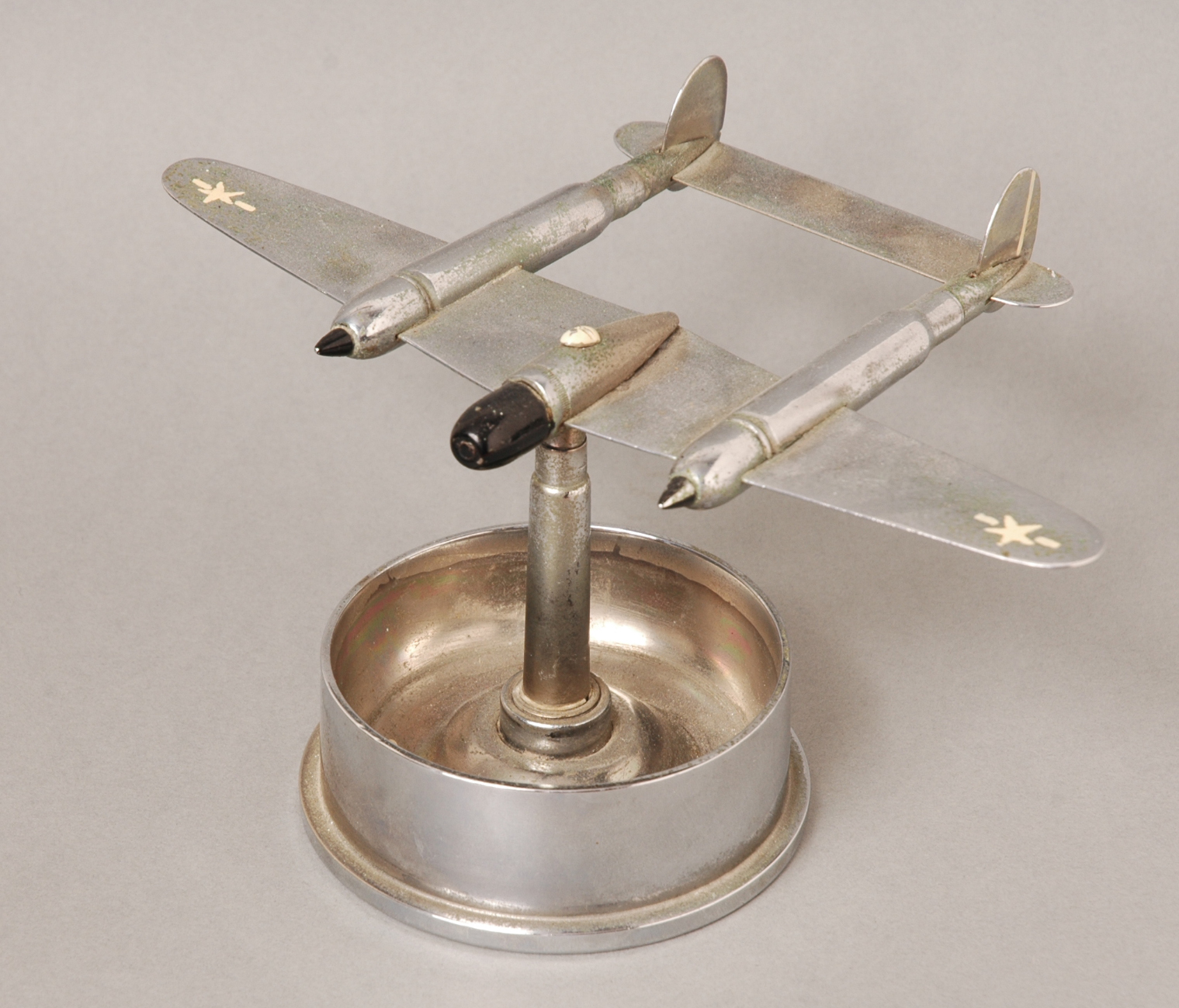
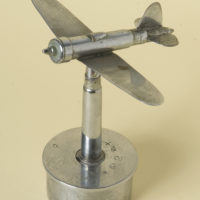
Harry’s most ambitious creations were the two model aircraft based on two iconic aircraft from the Pacific war theatre: the P38 and Japanese Zero (Figures 23 and 24). These are made from “deloused” rifle bullets and artillery shells.
The Zero was originally going to be of an American Corsair fighter, as flown by the New Zealand air force:
“There is a craze on here at this gun for making model aeroplanes out of rifle rounds and brass . They’re easily made and look very effective. I started it off with my model Corsair!” – Friday 10 March 1944
He somehow acquired a Japanese anti-tank shell and decided to make a model of the Japanese plane instead:
“March On mess duties again today – but I managed to finish my two planes complete with stands. I have a P38 mounted on a 6 pounder shell case and a Zero mounted on a Japanese 37 mm. anti-tank round. The Zero I first made as a Corsair but as it was to be put on a Jap shell base, I changed it to a Zero. About the only difference is the angle of the wing (the Corsair has gull-type wings).” – Friday 17 March 1944
The anti-tank gun Harry served on was a six-pounder. He must have been attracted to the idea of having the models mounted on the bases of anti-tank rounds whose origins were appropriate to the nationality of each plane.
The two models originally had clear plastic disks to represent their spinning propellors, but the plastic deteriorated over time and fell apart. All of these works were sent home to my mother from the islands and chrome-plated after Harry’s return.
-
- Figure 23
-
- Figure 24

Dad gave up making art of any kind when he returned to New Zealand and was discharged from the army. His time was taken up by more important matters: finding work, first in a timber mill in Ranui in West Auckland, then as a linesman with the Waitemata Electric Power Board (W.E.P.B.) in Henderson, and raising a family of three sons.
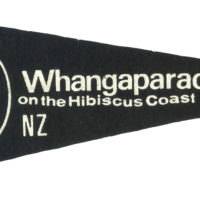
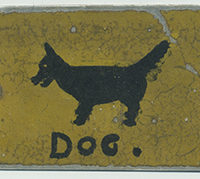
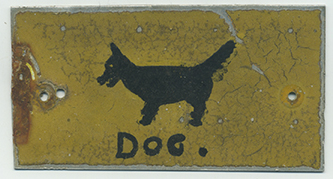
Harry’s last creative examples were created in his retirement at Red Beach on the Whangaparaoa Peninsula north of Auckland. He won a design competition for an insignia for the area by the local business association (Figure 25) which he was very proud of. His very last artwork was a small aluminium plate which was attached to the front gate alerting visitors to the presence of the family dog and beseeching them to keep it closed (Figure 26).
-
- Figure 25
-
- Figure 26
I have often wondered if he gave any thought to the irony of settling in two communities with such resonant names for participants in the Pacific War: Henderson, the name given to the airfield in Guadalcanal, and Red Beach, the area given to the part of Kukum Beach that he came ashore on in September 1943 (Figure 27).
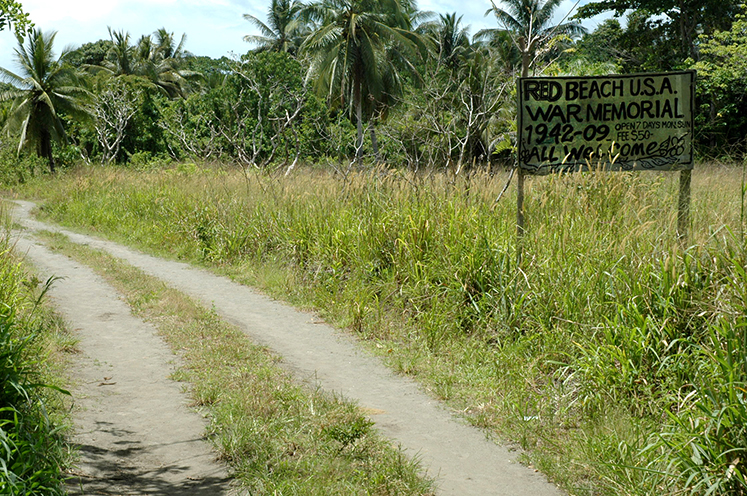
Figure 27